How to Rank in AI Overviews and AI Mode: What Google Says
Learn what Google requires for AI Overviews and AI Mode, which controls affect inclusion, and what Search Console can and cannot measure about supporting links.
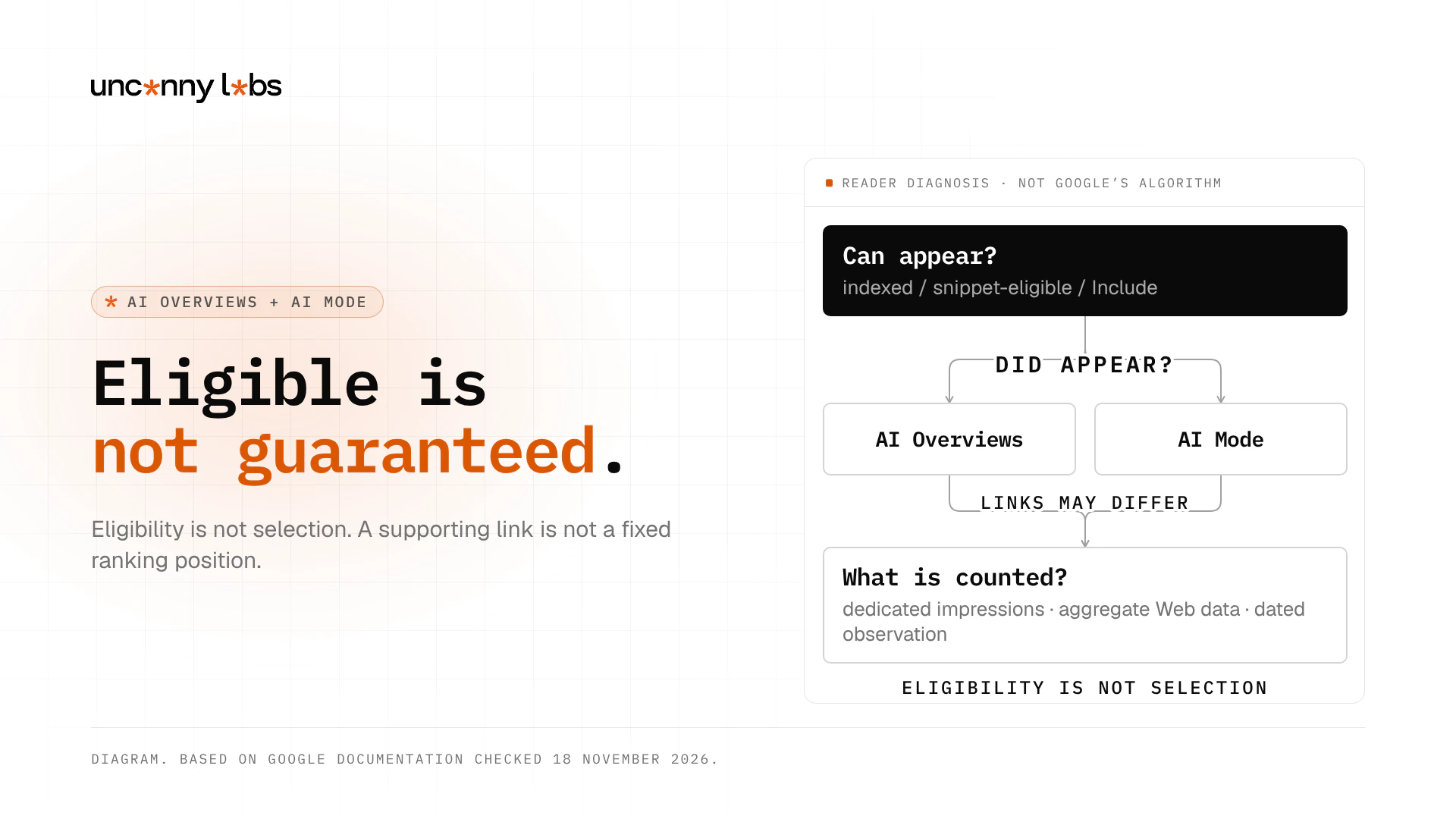
To appear as a supporting link in AI Overviews or AI Mode, make your page eligible for Google Search with a snippet, keep the applicable Search generative AI control on Include, and provide useful content, but Google does not guarantee selection or require special AI markup. This guide is for website owners and marketing leads: “rank” is the common search term, not a promise of a stable position inside an answer. Google's optimization guidance
Google documentation checked 18 November 2026
Key takeaways
- Indexed, snippet-eligible pages also need the applicable Include setting; eligibility does not ensure selection. Google guidance
- Both features may use related searches and show different supporting links. AI features documentation
- No special AI schema, text file or ideal word count is required.
- Search inclusion controls and Google-Extended serve different purposes.
- The dedicated AI report documents impressions; ordinary Web metrics and dated observations answer different questions. Search Console report
What does “rank” mean in AI Overviews and AI Mode?
For a publisher, the goal is a relevant supporting link, not a guaranteed numbered slot. An AI Overview summarizes a topic or question within Search; AI Mode supports deeper exploration, reasoning and comparisons through an interactive response. Both can link to supporting websites. Google's feature descriptions
Shared Search foundations, different responses
Google says these features rely on its core Search ranking and quality systems to retrieve relevant pages from the Search index. That does not mean classic results, AI Overviews and AI Mode show the same pages in the same order. Different models and techniques can produce different responses and links; an AI Overview may not trigger at all.
| Feature | Reader experience | Source behavior | What a publisher cannot infer |
|---|---|---|---|
| AI Overviews | Summary with links alongside Search results | May use related searches; appears when Google considers it additive | A permanent slot or appearance on every query |
| AI Mode | Interactive exploration and follow-up questions | May use different models, techniques and links | Identical source order to classic results or AI Overviews |
A supporting URL and a brand being named are separate outcomes: see named versus cited. For terminology beyond Google, see what SEO, AEO and GEO mean. Gemini Apps is a different product, outside this guide.
What makes a page eligible to appear?
A supporting-link page must be indexed and eligible for a Google Search snippet, with the applicable Search generative AI control set to Include. These are eligibility conditions, not a recipe for selection. Google's current optimization guide
Check eligibility before content rewrites
Google's technical requirements cover Googlebot access, a successful HTTP 200 response and indexable content. A publicly accessible, working page is not necessarily indexed. A URL blocked from crawling can still appear in Search, so a robots.txt block is not equivalent to a processed noindex instruction.
For the supporting-link requirement, check actual indexing and snippet eligibility, not just whether the URL loads in a browser. Keep the technical checks separate from the property-level participation control. Implementation details belong in indexable and snippet-eligible pages.
Eligibility is not a selection guarantee
Being indexed, snippet-eligible and included makes a page eligible for consideration, not entitled to a supporting link. Google explicitly says meeting its requirements and best practices does not guarantee crawling, indexing or serving. Eligibility cannot establish whether a particular response selected the page. Google guidance
Use Can appear → Did appear → What is counted as a diagnostic lens. First check eligibility, then a specific appearance, then the meaning of the report. This is an editorial framework, not Google's disclosed selection algorithm.
The content advice remains practical: make important facts available as text, link pages internally, keep markup consistent with visible content, and provide useful information beyond generic summaries. Those practices help readers; none guarantees an AI citation.
Why can related searches produce different supporting links?
Both features may issue multiple related searches across subtopics and data sources, rather than rely only on the words entered. Google calls this query fan-out. The documentation describes a possible mechanism, not a public log of the exact searches behind every response. Google's AI features guide
Google's optimization guide illustrates a lawn-weeds question with related searches about herbicides, removing weeds without chemicals and preventing weeds. Those are Google's illustrative queries, not observed hidden queries from a test conducted for this article.
The practical implication is limited: a page can address a relevant part of a broader question without repeating its exact wording. It does not follow that publishing one page for every imagined related query will earn inclusion. Google's spam policies prohibit scaled low-value production primarily intended to manipulate rankings; its optimization guide applies that warning to fan-out variants and generative responses.
For the wider mechanism, see retrieval and fan-out. A public result can show which URLs appeared, but cannot prove which internal query retrieved them or reveal the full candidate set.
Which controls affect Search AI inclusion?
Property participation, crawl access and page previews are different controls. Google-Extended addresses other documented uses, not inclusion or ranking in Search. A deliberate publisher restriction should not be treated as an error to remove automatically.
Property control, page controls and crawl access are different
Google's Search generative AI control documentation describes Include, Exclude and inheritance. Include is the default for properties without an inherited setting. A child follows the closest parent with a manually configured, non-inheriting choice, or the top-level domain setting if no closer parent has one. A child can override that choice.
An included domain therefore does not establish the effective setting of every child property. Read the applicable scope before attributing a missing link to content quality. Google states that the control rolled out worldwide as of 31 August 2026; that is Google's rollout statement, not an account-access test here.
| Control | Scope | Documented effect | What it does NOT mean | Source |
|---|---|---|---|---|
| Googlebot, robots.txt, CDN | Crawl access | Affects Search crawling; blocks can hide page directives | Targeted AI-only exclusion | Technical requirements |
| noindex | Page | Removes Search eligibility when processed | Only excluding AI features | Robots specifications |
| nosnippet | Page preview/input | Prevents text snippets and direct input to AI Overviews/Mode | Removing the URL from Search | Robots specifications |
| max-snippet | Preview/input amount | Limits text and direct-input amount; zero equals nosnippet | Ranking score; overriding separately permitted uses | Robots specifications |
| data-nosnippet | Marked text | Excludes marked text from snippets | Explicitly documented blanket model-input exclusion | Robots specifications |
| Include/Exclude/inherit | Applicable Search Console property | Governs links, content and grounding in listed Search AI features | Other Search ranking control or AI-training switch | Control documentation |
| Google-Extended | Product-use preference | Documented training and other-system grounding uses | Search inclusion/ranking control or separate AI Overview crawler | Crawler documentation |
Google-Extended is not the AI Overviews crawler
Google-Extended has no separate HTTP request user-agent string. Its crawler documentation covers training future Gemini models and grounding in Gemini Apps and Vertex AI. The Search control page also directs publishers to Google-Extended for limiting training of models behind Search generative features. The Search property control itself does not affect training or override separate Merchant Center and advertising choices.
For page rules to be processed, Google must be able to crawl them. max-snippet also has a separately permitted-use exception, including certain structured-data or licensed uses. The docs are less explicit about data-nosnippet excluding direct AI input than about nosnippet and max-snippet. See AI bot access and firewall rules for the crawl boundary.
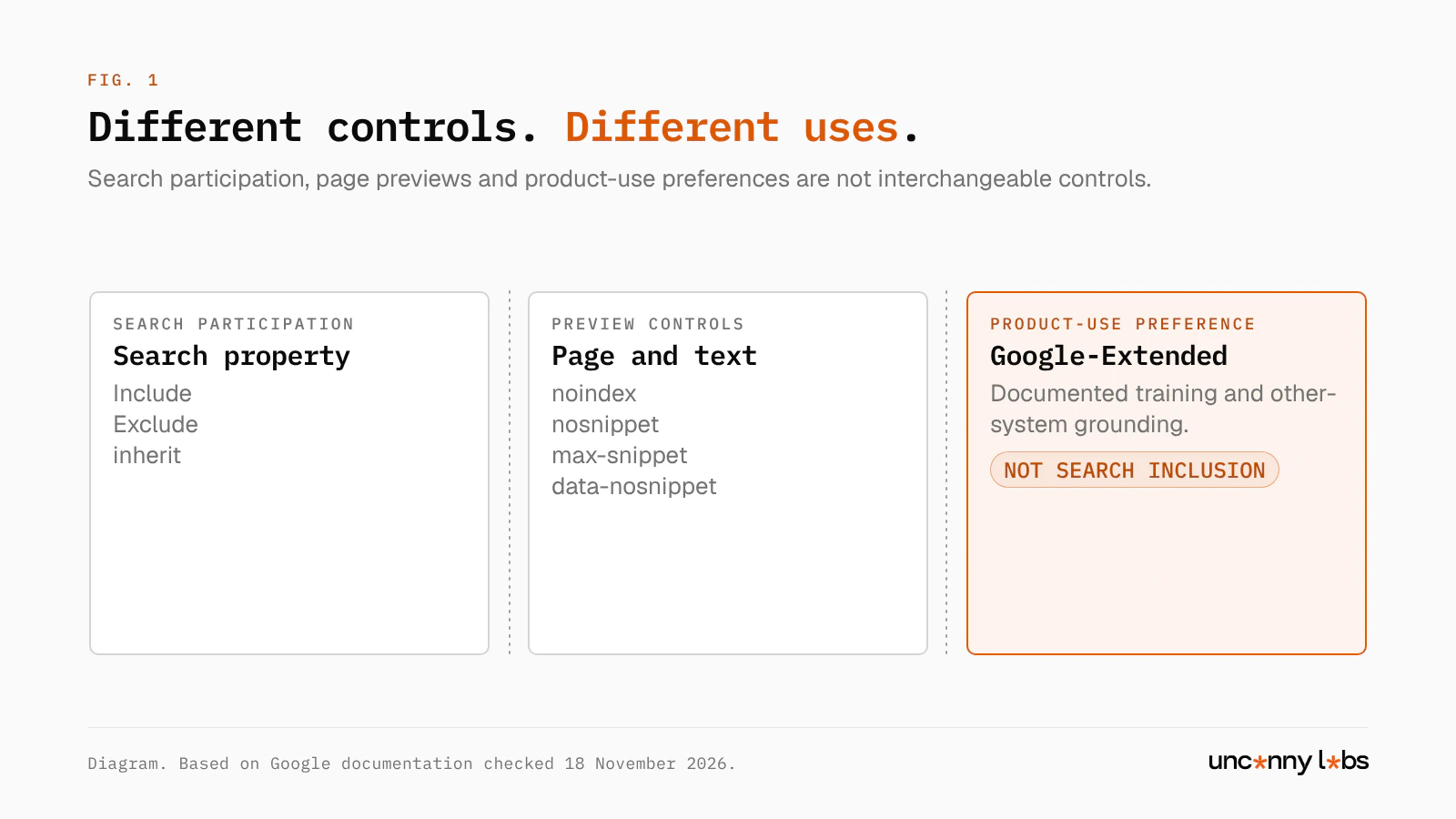
Check page-level directives without overriding publisher intent
Supported eligibility mechanism, not a selection promise. Before changing restrictions, confirm whether the publisher intends them. A request to improve visibility is not a reason to undo an intentional exclusion.
Inspect the actual page response and what Googlebot received, not only a CMS settings label:
- Check both
meta name="robots"andmeta name="googlebot", plus the HTTPX-Robots-Tagheaders. A header can impose a rule even when no matching tag appears in the page. Under Google's specifications, combined negative rules can be more restrictive than one tag inspected alone. - Look for
noindexandnone. When processed, noindex removes broader Search eligibility; it is not an AI-only exclusion. Google must be allowed to crawl the page to discover these directives. - Check
nosnippetandmax-snippet. nosnippet prevents text snippets and direct input to AI Overviews and AI Mode. max-snippet limits the amount;0is equivalent to nosnippet. A positive limit is not a citation score, and the documented exception for separately permitted uses, including certain structured-data or licensed uses, still applies. - Inspect
data-nosnippeton the answer'sspan,divorsectionelements. It excludes marked text from snippets. Do not expand that narrower documentation into a blanket direct-model-input exclusion.
There is no Google admission rule requiring a 50-character snippet or half the page to remain unmarked. Those are product-check heuristics, not published eligibility thresholds. Keep the applicable Include/Exclude/inheritance setting separate from these page checks and from Google-Extended.
If a restriction was unintended and a change is authorized, allow for recrawling and processing before assessing the result. Google's troubleshooting guidance says timing varies; do not promise a date or request recrawling merely because this checklist exists. Check eligibility again, then record any observed supporting link separately. The short visibility checklist is not a guarantee that Google will select the page.
What special AI optimizations does Google say you don't need?
Google does not require special AI schema, a new text file, tiny content chunks or an ideal answer length. Its optimization guide explicitly rejects treating those as requirements for generative Search.
No special schema, AI text file or ideal word count is required for these features. Google says Search ignores llms.txt and does not require writing in a particular way for AI. Clear headings, tables and concise answers are editorial choices, not guaranteed inclusion switches. Google guidance
| Claimed requirement | Documented distinction |
|---|---|
| Special AI schema | No special schema required; ordinary accurate markup can support rich-result eligibility |
| llms.txt or Markdown | No special Search treatment or visibility benefit from llms.txt |
| Fixed length or chunk size | No ideal page length; organize around the reader's task |
| Classic organic top ten first | Not a documented technical eligibility gate; core ranking systems still matter |
Read the broader llms.txt evidence and FAQ and HowTo schema explanations for those implementation questions. This article's FAQ represents visible answers; it is not presented as a citation lever. Google also warns against seeking inauthentic mentions, so manufactured brand references are not a substitute for useful content.
What can Search Console actually show?
Search Console documents dedicated AI impressions and broader Web performance, but those sources do not establish a stable supporting-link rank or complete AI-only attribution.
Dedicated impressions report versus ordinary Web performance
The Generative AI performance report covers link impressions in AI Overviews and AI Mode. Its documented dimensions are page, country, date and device, with text-based and multimodal Web views. It does not document standalone AI-only clicks, CTR, queries, positions or an AI Overview-versus-AI Mode split.
The older AI-features overview says these appearances contribute to ordinary Web Performance. The dedicated report describes a view of impressions from that Web data. These statements are compatible; neither means all AI measurement is unavailable or all AI traffic is separable.
| Source | Can establish | Cannot establish |
|---|---|---|
| Dedicated AI report | Link impressions aggregated by documented dimensions | Undocumented query, click, CTR, position or feature splits |
| Ordinary Web Performance | Aggregated clicks, impressions and positions under Search counting rules | AI-only conversions or source-list order |
| Dated observation and analytics | Appearance in that run; post-click events respectively | Hidden fan-out, comprehensive visibility or causal conversion lift |
Position methodology is not source-order proof
All links in an AI Overview share that result element's Search position. The dedicated AI report documents impressions, not an AI-only source-position metric. An ordinary average-position number therefore cannot establish “rank one inside the answer,” even though Search position metrics do exist. Counting rules and report documentation
External link clicks count under Google's methodology. AI Mode uses standard element-position rules, and each follow-up is a new query.
The dedicated report excludes Search Labs experiments. Its chart and table can use different aggregation, and most page data is assigned to canonical URLs. Google defines its date labels in Pacific Time; retain that source property when comparing exports rather than treating them as Shanghai calendar days. A missing report can reflect insufficient impressions or exclusion, not proof of deindexing. See the Search Console generative AI report and how to measure AI traffic.
How should you diagnose a missing supporting link?
Diagnose eligibility first, then interpret a limited observation. If the page is eligible but absent, the defensible conclusion is that selection was not established, not that one missing tactic caused the absence.
- Can appear: Check indexing, snippet eligibility and the effective Include setting at the relevant property scope. A browser's successful response alone is insufficient.
- Check restrictions: Distinguish intentional publisher choices from unintended crawl or preview barriers. Do not change those choices merely to improve a visibility checklist.
- Review the page: Assess whether it answers a real reader need, provides reliable information and makes key facts accessible as text. Improve the existing explanation rather than manufacture query variants.
- Did appear: Record the exact query, feature actually used, date/timezone, market, language and device. Note whether an AI Overview appeared, the supporting URL and whether the brand was named. Repeated observations can differ; this is not a prescribed sample size or a representative trigger-rate study.
- What is counted: Compare the documented report and analytics measures without converting correlation into a causal claim about an edit.
A normal Google Organic search for “how to rank in AI Mode” is still a search about AI Mode, not a conversational AI Mode test. The two paid research SERPs informing this update were ordinary Google Organic snapshots; no hidden fan-out or live AI Mode conversation was inspected.
Where do shopping and other AI apps fit?
Search source inclusion is separate from product discovery, checkout capability and customer payment authorization. Google says current Merchant Center and Business Profile information can help business and product information appear in its responses. Google guidance
For buying routes, see agentic commerce discovery and checkout limits. This guide does not extend Search participation controls to other AI apps. Gemini Apps is a different product from AI Mode; its optimization is outside this guide.
FAQ
These answers separate documented requirements, observed appearances and reporting limits.
How do I rank in AI Mode compared with AI Overviews? Both use shared Search foundations, with indexed, snippet-eligible pages and the applicable Include setting needed for supporting-link eligibility. Different models and techniques can produce different links, so classic results and the two AI features do not imply identical rankings. Meeting the requirements does not guarantee selection. Google guidance, AI features
Does my page need to rank in the organic top 10 first? Google does not document a classic top-ten position as a technical eligibility requirement for supporting links. Its core ranking and quality systems still retrieve relevant pages, so that is not a claim that ranking is irrelevant. Observational relationships between rankings and citations cannot establish a mandatory gate or guarantee inclusion. Google guidance
Do I need AI schema, llms.txt or a particular answer length? No special AI schema, llms.txt file or ideal page length is required for Google Search's generative features. Ordinary structured data should accurately match visible content and can support normal rich-result eligibility. Readable sections and this article's FAQ are editorial choices, not guaranteed citation factors. Google guidance
Can I opt out of Search AI features without removing ordinary Search results? The applicable property control offers Include, Exclude and inheritance for the listed Search generative AI features. Google says this choice is not a ranking or inclusion signal for other Search areas and does not affect training. A processed noindex instruction is different because it removes the page from Search more broadly. Control documentation, Robots specifications
Does blocking Google-Extended stop AI Overviews or AI Mode? No: Google says Google-Extended does not affect Search inclusion or ranking. It is a product-use token, without a separate request user-agent, for documented training and other-system grounding uses. Search participation and page preview controls address different decisions. Crawler documentation, Control documentation
Can Search Console show AI-only clicks, queries and supporting-link rank? The dedicated AI report documents impressions and specified dimensions, not those separate AI-only metrics or an AI Overview-versus-AI Mode split. Ordinary Web reporting includes AI activity, but all AI Overview links share the element's position rather than a source-list rank. AI Mode uses standard element-position methodology, with a follow-up counted as a new query. Report documentation, Counting rules
Why does an eligible page still not appear, or appear in only one feature? Eligibility does not guarantee selection, and an AI Overview may not trigger for the query. The two features can use different models, techniques and supporting links. Record the exact observed feature and conditions, then check eligibility without assuming one fix or a guaranteed timeline. AI features documentation
Sources
Official Google documentation supports the requirements and limits above. Documents opened 18 November 2026, Asia/Shanghai; retrieval dates are not feature-launch dates or property-access verification.
- AI features and your website.
- Optimizing your website for generative AI features on Search.
- Search generative AI control.
- Generative AI performance report, Search.
- Impressions, position and clicks.
- Google common crawlers and Google-Extended.
- Robots meta tag specifications.
- Search technical requirements.
- Spam policies, scaled content abuse.
Related resources
- Guide
Search Console's Generative AI report
What the impressions mean, what's missing, and how to read it next to the free check.
- Guide
How AI agents search, read and use the web
How search services, assistant apps and authorization boundaries differ when an agent finds, reads and uses web material.
- Guide
How to improve AI visibility
Improve AI visibility by checking crawler access, Google eligibility, readable content and off-site mentions. See which fixes have evidence and which do not.
- Guide
How to measure AI traffic
ChatGPT's UTM tag, a GA4 channel, Search Console and Bing, and what none of them can see.