How AI Agents Search, Read and Use the Web
See how AI agents find sources, read web pages and use information. Understand search services, assistant apps and the boundary before an action.
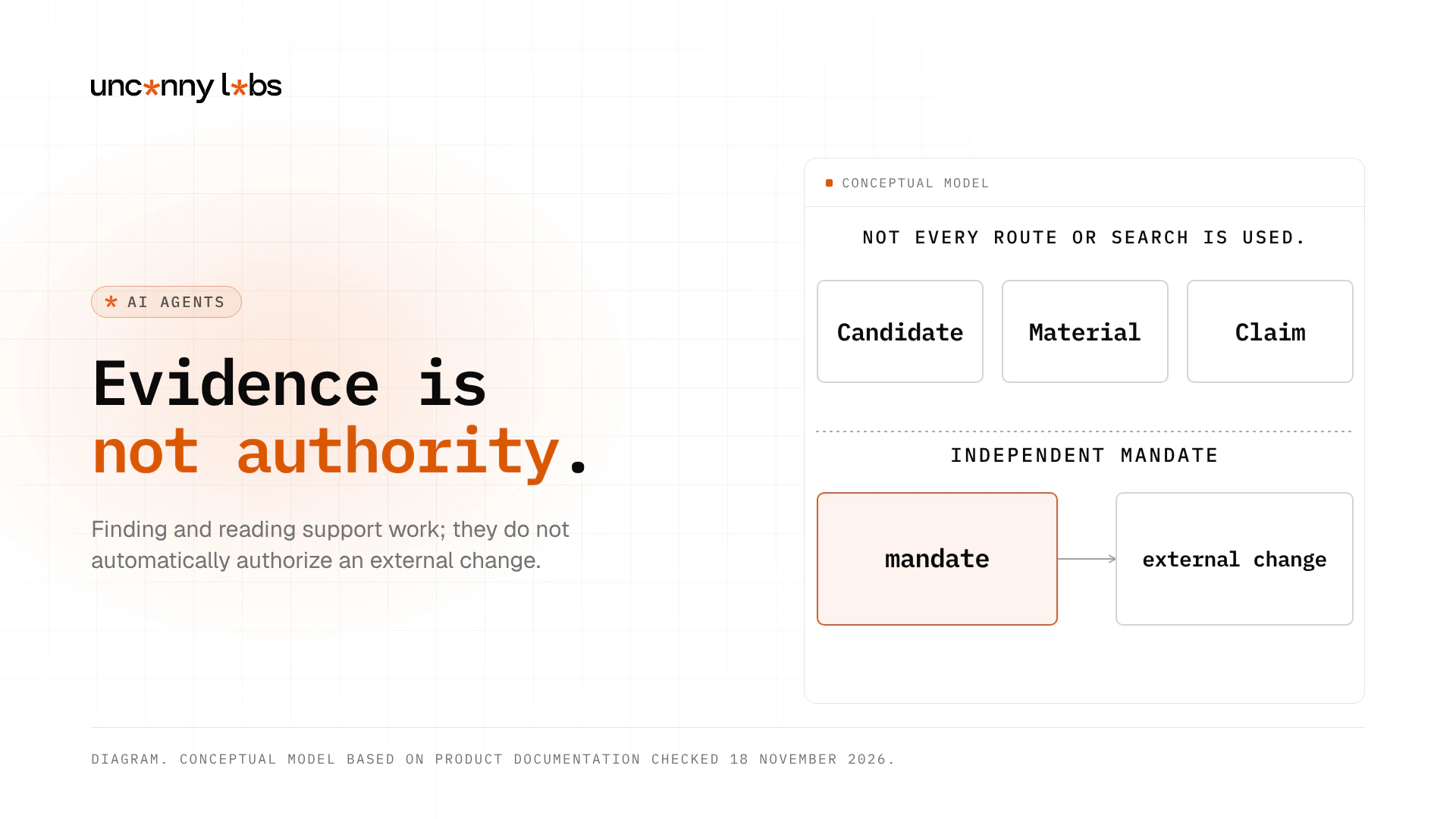
AI agents use search tools to find candidate sources, retrieve pages or other permitted material to read, and use that information in an answer or task; changing something outside the conversation requires a separately authorized action. Search, retrieval and action permissions are distinct parts of that explanation.
For publishers and marketing teams, the useful question is what crossed each boundary. An assistant can begin with a supplied URL or connected file, skip public search, or answer without a tool. Access to a site is not the same as AI visibility.
Documentation checked: 18 November 2026 (Asia/Shanghai).
Key takeaways
- A candidate URL identifies a possible source. It does not establish what the assistant read.
- Search and page content can arrive together. Firecrawl Search and Exa Search document combined requests.
- Services supply software functions; assistant apps package work for people. A service listing does not reveal an app's hidden providers.
- A known URL or permitted connected source can bypass public search. Claude documents direct-link fetching.
- Reading, drafting and making an external change have different authority requirements. Grok Bot's action rules depend on the task and applicable rules.
How do AI agents search the web?
An agent can use a search tool to obtain possible sources, inspect returned material and decide whether more evidence is needed. That process may repeat, but it is not a fixed sequence of network calls: Exa Search, for example, can return contents alongside search results.
Candidate, material, claim and a separate mandate
The evidence handoff: candidate → material → claim | separate mandate is an editorial teaching device. It is not a vendor architecture, tested score, technical standard or replacement for AgentReady's requirements.
| Boundary | Artifact | What it establishes | What it does not establish |
|---|---|---|---|
| Candidate | URL, title or snippet | A possible source entered the task | Complete reading or factual support |
| Material | Returned text, image, file or page representation | Particular information became available | That every part is current or relevant |
| Claim | Answer, comparison or draft tied to evidence | How selected material was used | That a link supports every assertion |
| Separate mandate | Authorized change and completion receipt | Scope and evidence of an external action | Permission inherited from reading |
These distinctions help explain a research result without guessing the implementation. A source can enter through search, a direct link or a connected account. Several sources might be read in parallel. The task can return to search if the available passages do not answer the question.
The framework also separates two questions often collapsed in reports: did the assistant obtain relevant material, and did its answer accurately use that material? A successful first step leaves the second question open.
Retrieval, fan-out and what a citation does not reveal
Supported; guidance only. An engine can retrieve a page without citing it. A citation identifies a selected source, not every candidate considered or the internal search that found it. For tasks that begin with supplied material, public search may not occur at all.
Google describes query fan-out as multiple related searches across subtopics and data sources that AI Overviews and AI Mode may use. That does not expose a complete query log. Chen and Koudas' October 2026 Toronto preprint, not peer reviewed, found retrieval particularly important in its studied ChatGPT API setup. It is not a guarantee about every model, market or app.
Ahrefs' March 2026 overlap update compared citations with results for the same original query and used changed parsing. Its proposed fan-out explanation is a hypothesis, not a measured cause or a current performance target. Do not commission a page for every imagined subquery.
Buyer questions are not the engine's retrieval set
Supported, with a limited proxy. An accurate title, H1 and answer should use the vocabulary of the buyer question they address. Cover that question once in the appropriate page, rather than repeat it across near-duplicates. The buyer-language checklist is a writing check, not access to the engine's searches.
The Toronto preprint compared pages within the same websites across two commercial markets. Query relevance remained informative where several fashionable page features did not. That supports answering the right question, not treating a coefficient as universal or promising a citation from one title edit.
A lexical-overlap check compares supplied words. It is not live fan-out, an embedding measurement or the hidden retrieval set. A percentage passing a product check is therefore not an engine threshold. Without task traces, candidate searches can remain unknown even when the final answer contains a source link.
Finding a result is not the same as reading a page
A result can supply a title and a short passage without returning the whole page. The returned representation matters: Tavily Search documents content snippets, while its Extract documentation distinguishes successful and failed URL results.
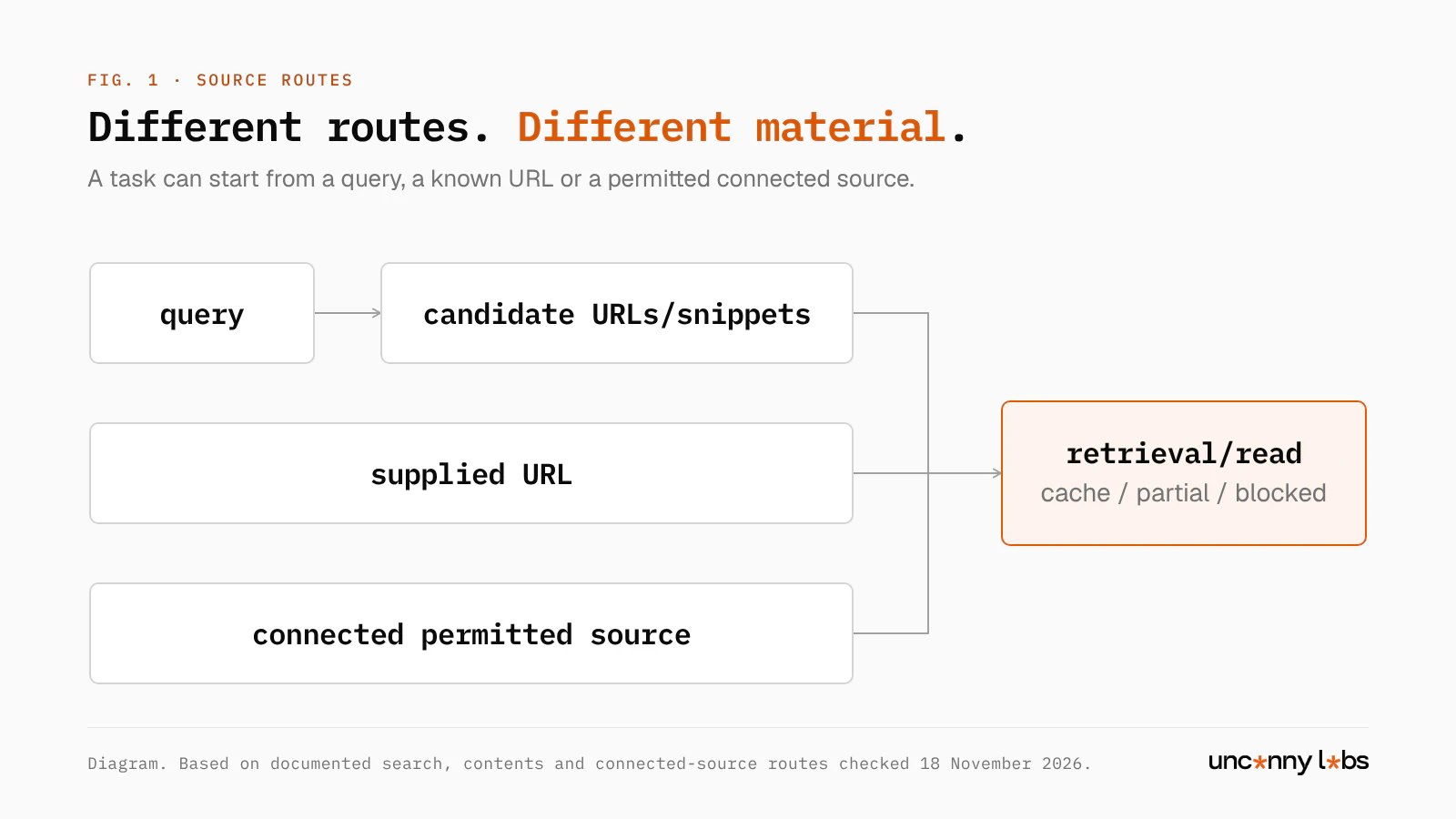
Start from a query, URL or connected source
| Route | What can arrive | What to check |
|---|---|---|
| Search query | Candidate URLs, snippets, sometimes page content | Which content actually accompanied each result |
| Supplied URL | Extracted text, HTML or another supported format | Whether it returned and what was omitted |
| Site crawl | Multiple discovered and retrieved pages | Site scope, limits and failed pages |
| Connected source | Permitted files, messages or records | Account access and allowed use |
| Browser | Rendered page or screen-derived material | Login, site blocks and required human steps |
These routes are documented in Firecrawl Scrape, Crawl, Claude connectors and Grok Bot's browser guidance. They are alternatives, not features every app necessarily offers.
Snippets, extracted text and rendered pages
A screenshot preserves a visual view; extracted text is a different artifact. A browser route does not establish that every hidden panel or linked document was inspected. Equally, it would be wrong to assume agents can never handle rendered pages: Firecrawl documents dynamic-page handling, and Grok Bot documents browser work.
Freshness also needs evidence. Exa Contents documents cached results with live crawling as fallback for uncached pages. A retrieval timestamp therefore need not be the time the underlying page was freshly fetched.
For publishers, the implementation questions belong with putting main content where it can be read and crawler access and firewall controls. A blocked or partial response should remain a documented limit, not become a claim about unseen content.
When a snippet is all that is read
Listing: Unproven; method: Mixed, weight 1. The effect of fixing snippets on citations is unproven. Keep that distinction even though snippet-only reading has been observed.
In Walters, Chen and Toni's October 2026 preprint, the deployed proprietary model answered 53.6% of episodes from snippets without opening a page. The authors tested the lightest of three tiers in that deployed setting; this is not a cross-engine rate. The study links snippet reliance with stale answers and unfaithful citations, not a proven publisher intervention.
A stale passage can therefore survive in an answer despite newer facts elsewhere. Give the title, description and opening paragraph accurate, independently useful facts, while recognizing that engines can rewrite titles or ignore descriptions. Google primarily generates snippets from page content. The metadata checklist is hygiene, not a universal length rule or a citation promise.
Check the initial HTML
Supported pragmatic readability advice. Use View Source or the raw response to find the main answer, then compare it with the browser's rendered document. Developer-tools inspection after scripts run is not the same check. A collapsed answer already in the HTML differs from text fetched only when someone clicks.
If essential material is absent, ask about server-side rendering or static generation, which can put it in the initial response. Do not generalize Vercel and MERJ's December 2024 crawler observations into “agents never render JavaScript.” An October 2026 publisher log report suggests limited OpenAI rendering; it is not a vendor guarantee, and which sites receive it remains uncertain.
The browser and dynamic-page capabilities described above still apply. There is no minimum article-character threshold here. Diagnose crawler access and firewall controls separately from whether the returned material contains the answer.
What do Firecrawl, Exa and Tavily provide?
Firecrawl, Exa and Tavily provide services software can call to find or return web material. An API is a structured software interface. MCP is a protocol through which assistants can access compatible tools and data; neither label identifies which service an app uses internally.
| Service/layer | Search-discovery role | Read-content role | Boundary to remember | Primary source |
|---|---|---|---|---|
| Firecrawl, API/service | Search returns URLs, descriptions and highlights | Optional search scraping; known-URL Scrape and site Crawl | Interaction capability does not confer authority | Search, Scrape |
| Exa, API/service | Search returns relevant results | Search can include contents; Contents accepts URLs | Returned content need not be freshly crawled each time | Search, Contents |
| Tavily, API/service | Search returns results with relevant content | Extract handles specified URLs; Crawl traverses sites | Content and per-URL success require inspection | Search, Extract |
Firecrawl
Search can combine discovery and page scraping in one call. Scrape starts with a known URL, while Crawl follows a site's pages within configured scope and limits. Those purposes overlap without making every operation equivalent.
Interact separately documents clicks, form filling and navigation. Calling Firecrawl only a scraper would omit that capability, but the existence of a form-submission tool says nothing about whether a particular user authorized submission.
Exa
Exa Search can return contents as well as candidate results, so it does not fit a discovery-only category. Contents accepts supplied URLs and returns page contents and metadata without requiring a new search first.
Its documented cache and fallback behavior matter when interpreting evidence. A successful response supports a statement about returned material; it does not independently establish a fresh full-page read or reveal a consumer app's recommendation logic.
Tavily
Tavily Search returns query-related content with results. Extract works from specified URLs, while Crawl explores a website with extraction.
Extract explicitly separates successful URLs from failed results, even when the overall response is HTTP 200. That is a concrete reason to inspect the returned material rather than treat request-level success as proof every source was read. These documented functions are not a quality ranking of the services.
How do Claude, Gemini, Grok and Grok Bot use web tools?
These are user-facing apps with documented native features and optional connected sources or tools. Their documentation describes different routes and controls. Placing them beside web services does not establish any provider relationship.
| Layer | Examples | Role in a request | Does not establish |
|---|---|---|---|
| Services/APIs | Firecrawl, Exa, Tavily | Supply software functions for finding or returning material | An app's backend or a guaranteed citation |
| Apps | Claude, Gemini, Grok, Grok Bot | Accept a person's request and organize supported work | Shared features, permissions or source-display rules |
The distinction concerns the products and functions discussed here, not a claim that vendors cannot offer other products.
| App | Documented native route | Connected route | Important limit | References |
|---|---|---|---|---|
| Claude | Web search and direct-URL fetch | Apps supplying data and supported actions | Workspace controls and source permissions apply | Search, connectors |
| Gemini Apps | Public Google Search information; Deep Research | Selected apps, files and permitted private sources | Availability and source displays vary | Connected Apps, sources |
| Grok | Live web and X search | Authenticated email, files, calendar and other tools | A maintained connector still needs authentication | Product, connectors |
| Grok Bot | Persistent cloud browser/computer work | Connected apps and custom tooling | Site blocks, account access and action rules constrain work | Computer and apps, FAQ |
Claude
Claude's help page documents native web search and fetching pages from supplied URLs. An external search-service connector is therefore not a universal prerequisite. Workspace owners control search availability for team accounts; the documented newer experience has no separate search toggle.
Connectors add data and actions within source-system permissions. Organizations can further restrict tools. Permission to read a file and permission to modify it remain separate controls.
Gemini Apps
Connected Apps guidance distinguishes public Google Search information from personal content. Deep Research includes Search by default, but users can change sources. That feature's default is not evidence that every Gemini answer searches.
Source links appear sometimes and may relate to websites, uploads or connected Workspace material. General app availability varies by device, location and account. Current custom-app requirements specify US users aged 18 or over, English, a personal Google Account and History on; connection happens through the web app. These are Gemini Apps, distinct from Google AI Overviews and AI Mode.
Grok
Grok's product page describes live web and X search. Its app overview separately documents connected email, files and calendar, while connector documentation distinguishes maintained, catalog and custom integrations.
Maintained or built-in does not mean already authenticated. Business and Enterprise administrators must provision connectors before members can use them. Product descriptions of live sources should not be read as independent proof that every answer is current, correct or comprehensively cited.
Grok Bot
The official FAQ explicitly says Grok and Grok Bot are different apps. Grok Bot documents work through a persistent cloud computer, browser and connected tools. Adding an app is distinct from authentication; some websites require human steps or block automation.
Public Grok Bot documentation is available. The reviewed pages do not specify default search-provider routing or a comprehensive citation/display guarantee. No connection to Firecrawl, Exa or Tavily follows from their inclusion in this guide.
For the other platform-specific questions, see ChatGPT search and source controls and Perplexity citation behavior.
How does retrieved material become an answer?
The assistant selects material and uses it in a response, comparison or other work product. Checking that output requires comparing each important claim with the passage that supposedly supports it, including its date and scope.
Evidence check: A source link identifies a place to inspect. Establishing support still requires reading the relevant passage and distinguishing what it says from what the assistant inferred.
Gemini's source guidance illustrates why the distinction matters: links may supply related content, including uploaded or connected material. They are not all evidence of a public-web search. Claude's search guidance also tells users to verify important information and cross-reference sources.
Tavily Extract provides a practical example: when a query is supplied, it can return selected relevant chunks rather than all page content. An answer based on those chunks has evidence from those passages, not proof that every qualification elsewhere was inspected. A missing qualification calls for more reading or a narrower claim, not an assumption about the rest of the page.
For a capability claim, compare the product, account and action described in the source with those named in the answer. A statement about a custom connector's write confirmation cannot establish a policy for every native tool in every app. Likewise, a passage describing retrieval does not support an added claim about recommendation frequency.
For publishers, being cited and being named are different outcomes. An assistant can use a page as evidence without recommending its publisher. A source supplied by the user also answers a different question from whether the assistant independently discovered that source.
Where is the boundary between reading and acting?
An external change needs a supported action, appropriate account access and a mandate covering that change. The required approval mechanism depends on the product, tool and applicable rules; it is not necessarily a new prompt before every action.
Capability, access, authority and confirmation
| Situation | Capability/access needed | Separate authority or confirmation question | Limit |
|---|---|---|---|
| Read a public page | Search, fetch or browser route | Does the task cover this research? | Reading grants no write authority |
| Read a private record | Correct connected account and scope | Is this information within the task and permitted use? | Access does not permit blanket disclosure |
| Prepare an answer or local draft | Supported evidence | Is the deliverable still a draft? | Preparation is not publication |
| Submit, send, edit or publish | Supported action and account permissions | Which target and change are authorized under the applicable rules? | A tool's presence is not a mandate |
| Report completion | Observable result in the destination | What confirms success or failure? | An attempted action is not a completed change |
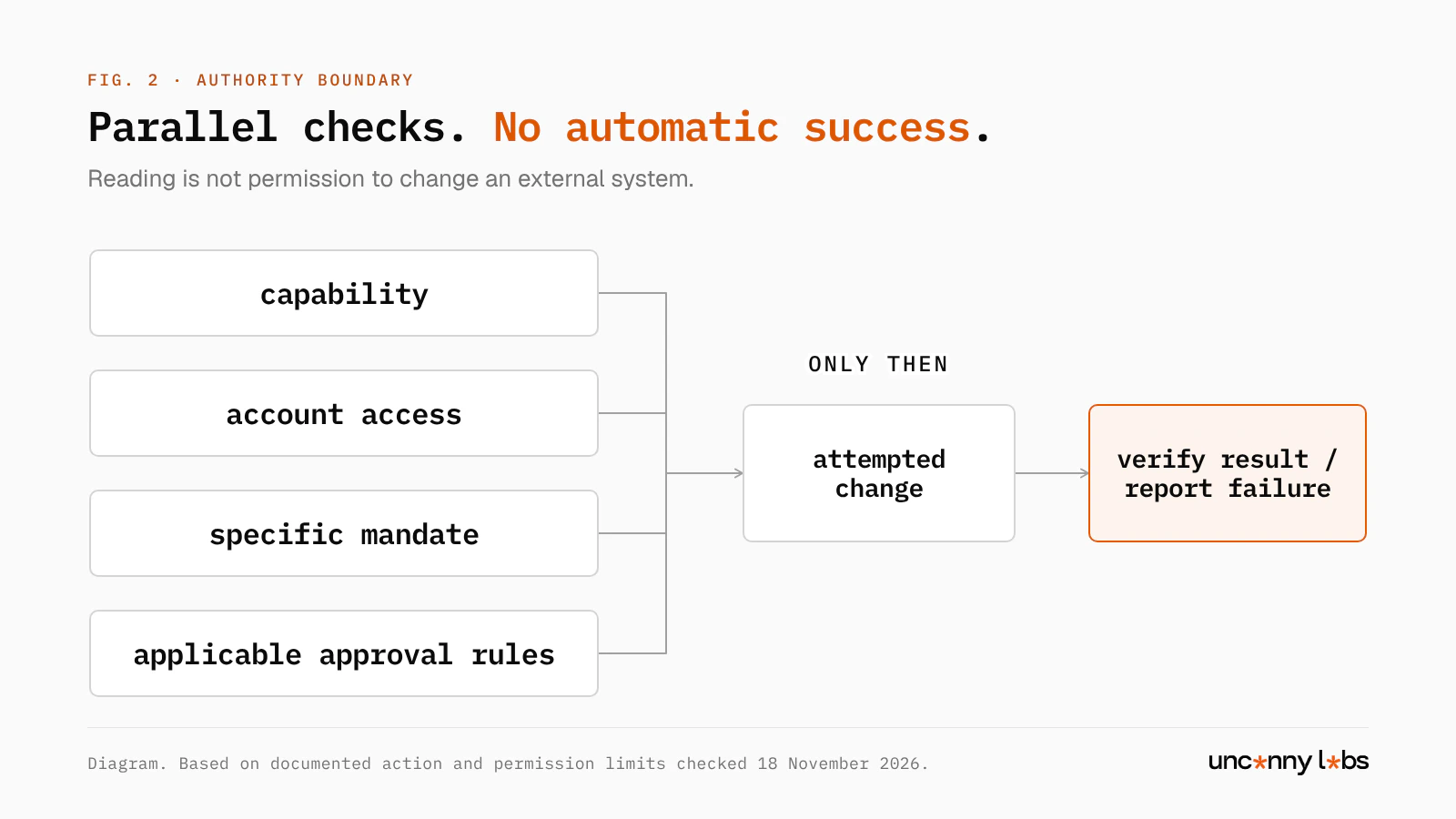
This is an editorial explanation, not a shared vendor security standard. Firecrawl Interact establishes interaction capability. Claude's connector controls distinguish allowed, approval-required and blocked tools alongside source permissions. Gemini's custom-app guidance currently requires manual write confirmation for that feature and warns that mistakes remain possible.
A scoped standing authorization can cover repeated work. Its existence still needs to be established; signing in or asking for research does not, by itself, specify a recipient, destination or external change. The separate guide to agentic commerce and checkout limits covers that particular action context.
Page content cannot grant a mandate
Grok Bot's documentation distinguishes user instructions from harmful instructions found on a page and acknowledges residual risk. Retrieved text should be evaluated as evidence, not treated as permission to expand the task. Protective controls reduce risk without guaranteeing safety or successful completion.
What should publishers and marketers take from this?
Describe the observed route and output before drawing a visibility conclusion. Useful evidence identifies the app, how the source entered, what material returned and which claim used it. If the observation stops at a snippet, report a snippet rather than a full-page read.
Keep capability evidence separate from outcome evidence. Documentation can explain that a tool accepts URLs; only the observed task can establish whether a particular URL returned useful material. Neither establishes an unsolicited recommendation or a successful external change.
A compact evidence receipt can retain the source URL, relevant passage, retrieval method and limits alongside the answer being assessed. Unknown routing should remain unknown rather than being filled in from a service logo or connector catalog.
For site implementation, use the site-readiness checklist. The evidence-handoff model explains the questions to ask about a task; it does not replace technical requirements or promise appearance in an answer.
FAQ
Can an AI agent read a URL without searching first?
Yes, where the app or service supports direct retrieval from a supplied URL, as Exa Contents and Claude web fetch document. Access restrictions or retrieval failures can still prevent useful material from returning.
Does a search result mean the agent read the whole page?
No: a result may contain a snippet, selected chunks or additional page content, depending on the tool and request. Tavily's Extract documentation shows why returned content and failed URLs need separate inspection, even when a request succeeds.
Are Firecrawl, Exa and Tavily the same kind of product as Claude or Gemini?
The functions discussed here are service/API functions software can call, whereas Claude and Gemini are user-facing apps. Services can combine jobs: Firecrawl Search, for example, can discover results and optionally retrieve their content in one request.
Do Claude and Gemini always need an external web-search connector?
No: Claude documents native web search, and Gemini Deep Research includes Google Search by default. Connected tools add particular sources or functions, subject to account settings and availability rather than one universal requirement.
Are Grok and Grok Bot the same app?
No, the official Grok Bot FAQ explicitly distinguishes them. Grok Bot's documented browser/computer and connected-app routes do not establish that it shares Grok's search routing or source-display behavior.
Can a page authorize an agent to submit a form or publish something?
Page text is not a mandate from the user to change an external system. The action needs supported capability, account permissions and authority under applicable rules; Grok Bot's documentation also warns that protections against harmful page instructions do not remove all risk.
Does being accessible to an agent mean my brand will be cited?
No: access, selected material and the resulting answer are separate questions, as the readiness-versus-visibility comparison explains. Even a citation does not necessarily name or recommend the publisher, and no route described here guarantees those outcomes.
Sources
Capabilities checked 18 November 2026 (Asia/Shanghai). Official documentation describes supported functions and limits, not independent performance tests; availability may change.
- Firecrawl Search
- Exa Contents
- Claude app: Use connectors
- Exa Search
- Claude app: Enable and use web search
- How Grok Bot works
- Tavily Search
- Tavily Extract
- Firecrawl Scrape
- Firecrawl Crawl
- Grok Bot FAQ
- Firecrawl Interact
- Tavily Crawl
- Gemini Apps: Connected Apps
- Gemini Apps: View related sources
- Grok consumer product page
- Grok app connectors
- Grok Bot: Use the computer and apps
- Gemini Apps: Deep Research
- Gemini Apps: Custom connected apps
- Grok app overview
Related resources
- Research
Agent ready vs AI visibility
Does your site work for AI agents, and do AI answers name you? Two questions, two different checks.
- Guide
How to get ChatGPT to mention your brand
What ChatGPT search, crawler controls and business profiles can and cannot do for brand mentions.
- Guide
How to get cited by Perplexity
What PerplexityBot and Perplexity-User do, how search modes affect citations, and why access cannot guarantee inclusion.
- Article
The AgentReady spec
What the open AgentReady spec (v2.0) requires: find, read and act, and which practices apply to your site.