How to improve AI visibility
Improve AI visibility by checking crawler access, Google eligibility, readable content and off-site mentions. See which fixes have evidence and which do not.
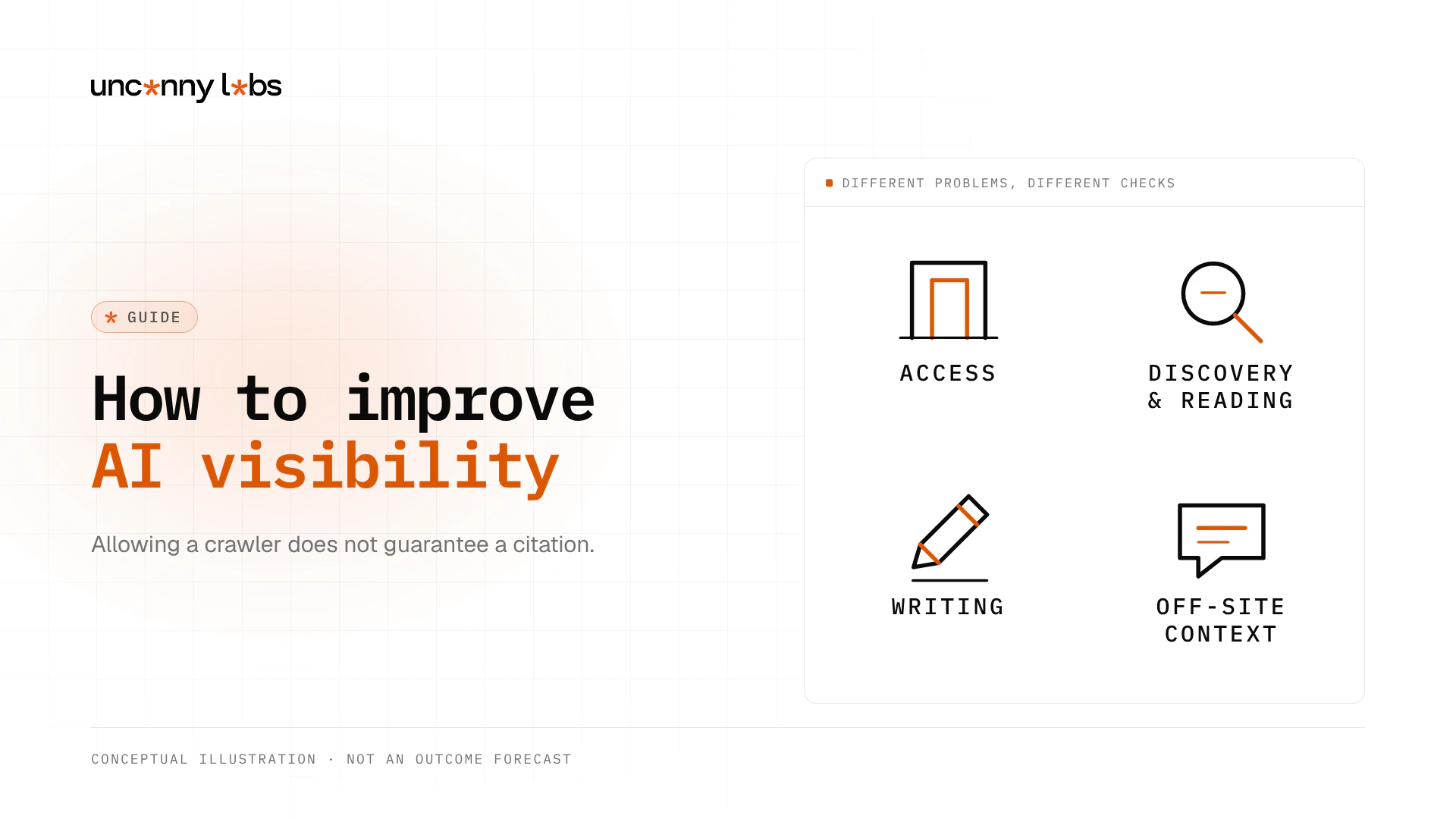
To improve AI visibility, remove unintended access barriers, make useful answers readable, and check how relevant sources describe your business. These steps address different problems. Allowing a crawler does not guarantee a citation, and a citation does not mean an answer recommends your brand.
For business owners and marketers, start by identifying what is missing before commissioning more content. This guide separates practical checks from advice whose citation benefit remains uncertain.
Key takeaways
- Fix unintended crawl and preview restrictions before rewriting. Google documents eligibility, not guaranteed selection.
- Match real buyer questions; do not manufacture pages for imagined AI searches.
- Search snippets can become answer material without a full-page read. That mechanism is not proof that editing metadata increases citations.
- Keep named, cited and recommended separate. The Toronto preprint studies distinct retrieval and brand-knowledge effects, not a universal recipe.
What this page is, and how evidence grades work
Use these labels to judge the advice, not predict a result. The evidence grades and limits explain their provenance separately.
| Label | What it means here |
|---|---|
| Supported | Evidence supports the stated mechanism or association; outcomes are still mostly observational, not promised. |
| Mixed | Findings vary by setting, conflict, or support a reading habit rather than a settled citation lever. |
| Unproven | Citation benefit is not established. Valid hygiene can still be useful. |
| Info/ungraded | Discovery or interoperability information, not evidence of citation lift. |
Start with the observed problem. If a page cannot be read, investigate access. If it can be read but is absent from an answer, absence alone does not identify the cause.
First, remove blockers
Let AI bots in
Supported for access, not mentions. Check the relevant search bot's robots.txt group and your firewall or content delivery network (CDN). Keep training choices separate. A successful third-party probe proves only that test worked. Use the robots groups and access checks, including user-fetch exceptions and private-path exclusions.
Let Google show and cite you
Supported eligibility mechanism. Confirm indexing, snippet eligibility and the applicable Search generative AI Include setting. Review restrictions with the publisher before changing them. The page-directive checks distinguish page previews, property participation and crawl access. Eligibility is not selection.
Content in the first HTML
Supported readability advice. Ask whether the main answer arrives in the initial HTML, rather than only after JavaScript or a click. Do not assume every agent has the same rendering capability. Use the initial-HTML check before requesting a technical change.
Get retrieved
Match the buyer's question
Supported, not guaranteed selection. Use the buyer's actual vocabulary in an accurate title, H1 and answer. Cover the question once, where it belongs. A word-overlap check cannot reveal an engine's hidden searches. See buyer questions versus the retrieval set for that limitation.
Show up in the agent's own searches
Supported; guidance only. Address relevant needs rather than produce a page for every imagined subquery. A citation shows selection, not the full candidate set considered. The retrieval and fan-out explanation separates observed sources from searches you cannot see.
Rank and earn links
Mixed; off-site guidance. Keep useful pages findable through ordinary search and relevant links. Google still uses core Search systems. But Ahrefs' changing overlap findings are dated observations, not a top-ten admission rule or proof that obtaining backlinks causes citations. One page fetch cannot grade an off-site link profile.
Write so a passage can be extracted
Answer first
Mixed. Put a direct answer before supporting detail, under natural question headings where useful. Across-site patterns can disappear when pages within the same site are compared, as the Toronto preprint shows. Treat this as readability, not a settled lever. Google specifies no mandatory chunks or ideal answer length.
Skip the filler
Supported anti-spam advice, not proven positive lift. Read the page aloud. Remove forced repetition and city lists that add nothing, while keeping useful buyer vocabulary. Google's keyword-stuffing policy is not a published keyword-density target. Do not replace awkward repetition with a new percentage rule.
Make the snippet carry the answer
Listing: Unproven. Method: Mixed, weight 1. The labels differ; the effect of fixing snippets on citations is unproven. Check that the title, description and opening facts each make sense independently and agree. Engines may rewrite or ignore descriptions. See snippet-only reading limits; this is not a universal character-count rule.
Comparison phrasing, when true
Mixed; title check informational. Use “best” or “versus” only for a page that genuinely compares options. Ahrefs observed list prevalence in recommendation prompts; it did not establish that adding a word causes citations. Absence of comparison phrasing is not a defect, and an owned comparison is not independent third-party inclusion.
Cite sources, stats and experts
Mixed. Link original evidence, retain the dates and context of real numbers, and attribute quotations accurately when they help. The GEO paper's controlled visibility experiments are not a live ChatGPT citation-rate increase. Add no statistic, expert or quotation merely to reach a quota.
Show fresh dates
Mixed. Label publication and substantive update dates, keeping visible dates consistent with machine-readable datePublished and dateModified. Google explains date consistency. Ahrefs' cited-page age analysis does not prove changing a displayed date earns citations; its first-seen age measure is not a last-updated field. Do not fake freshness or impose a universal annual refresh.
Files and markup we do not weight
These are not citation-score shortcuts. A consistency problem can warrant a repair even when adding a file or markup has no established lift.
FAQ and HowTo markup
Unproven for citation lift. If Q&A already exists, ensure the visible answers and markup agree, preferably generated from one source. Expandable text already in the HTML differs from text fetched only after a click. Google requires representative structured data; accurate markup does not establish a citation benefit.
Say who you are
Unproven for citation lift. Use the real business name, URL, logo and official sameAs profiles consistently. Choose Organization or the relevant LocalBusiness type to fit the business. Google describes disambiguation, not a measured citation boost. Brand understanding and citation frequency are different outcomes.
Publish a sitemap
Info/ungraded. Keep a clean discovery list of canonical pages and a robots.txt pointer. It does not grant access or guarantee crawling, indexing or citations. The sitemap discovery checks belong after access diagnosis, not as a fourth gate.
llms.txt, honestly
Unproven; not weighted. Do not add this file to earn citations. A valid existing file can remain for its intended use. Google says Search ignores llms.txt; that statement is about Google Search, not proof that no tool can consume it. A specification's recommendation is not outcome evidence.
Early AI agent standards
Info/ungraded. The dated catalog below preserves distinct jobs, not twelve citation requirements. Version notes describe the October 2026 inventory, not a current-adoption audit; consult the linked specifications before implementation.
| Convention | Job and dated context |
|---|---|
| Content Signals | Content-use preferences; Cloudflare policy launched September 2025. |
| IETF AI preferences | Attaching use preferences; working-group draft. |
| RSL | Machine-readable licensing; 1.0, December 2025. |
| Markdown | Alternative page representation; Cloudflare feature. |
| MCP server card | Pre-connection server discovery; SEP-2127 Final. |
| Skills index | Discovering loadable skills; Cloudflare draft 0.2.0 in the inventory. |
| API catalog | Public API discovery; RFC 9727, June 2025. |
| A2A card | Discovery between callable agents. |
| UCP | Commerce interoperability, including checkout. |
| ARD | Agentic-resource discovery; v0.91 proposal, August 2026. |
| WebMCP | Page-exposed tools; Community Group draft. |
| poppy.json | Personal-agent interaction/sign-in; October 9 draft 0.1, followed by breaking 0.2 changes. |
Some have real protocol or tool consumers. That is not evidence of publisher citation lift. Consider the relevant convention only if you offer the corresponding API, server, agent, shop or service; do not install every file on an informational site.
Earn mentions off-site
These are guidance-only actions. An owned-page check cannot establish independent coverage, and being named or cited is not the same as being recommended. Use Named vs cited to diagnose the particular prompt and engine.
Be in the threads
Mixed. Give genuine answers where buyers already discuss the subject, not drive-by links. Platform citation patterns differ; a forum's citation share does not measure the benefit of posting there. See forum and thread presence.
Get on the 'best' lists
Supported listing label; guidance only. Assess relevant independent comparisons, not merely “best” in your own title. Observed list prevalence does not measure outreach success or justify manufactured placements. See third-party lists and comparisons.
Earn coverage and reviews
Supported label; guidance only. Inspect publisher and review sources actually cited for relevant questions and whether they name the business. Generic clipping volume cannot establish that result. See coverage and reviews; obtaining coverage guarantees neither naming nor citation.
Get talked about
Mixed. Web and YouTube mention correlations vary by platform. They are not causal effects or separate replications each time the same study appears. An owned-name-consistency check is not a mentions index. See wider web and YouTube mentions.
Sources
Primary documentation and original studies are linked beside the claims they support. Evidence labels retain the approved historical listing provenance; they are not fresh efficacy measurements. The separate method page remains unchanged. No archived booking link is used as evidence.
Related resources
- Guide
What stops AI crawlers
Robots.txt, your firewall and the AI company's own list can each stop an AI agent. The free check tests the first two.
- Guide
How AI agents search, read and use the web
How search services, assistant apps and authorization boundaries differ when an agent finds, reads and uses web material.
- Guide
How to rank in AI Overviews
What Google requires for AI Overviews and AI Mode, which controls affect inclusion, and what Search Console can measure.
- Guide
Named vs cited
Why AI answers can name your brand without citing your site, and how to check both.