Named vs Cited: Why AI Answers Can Name Your Brand Without Citing Your Site
Brand mentions vs citations: AI answers can name your brand without citing your site, or cite your page without naming you. Learn how to check both.
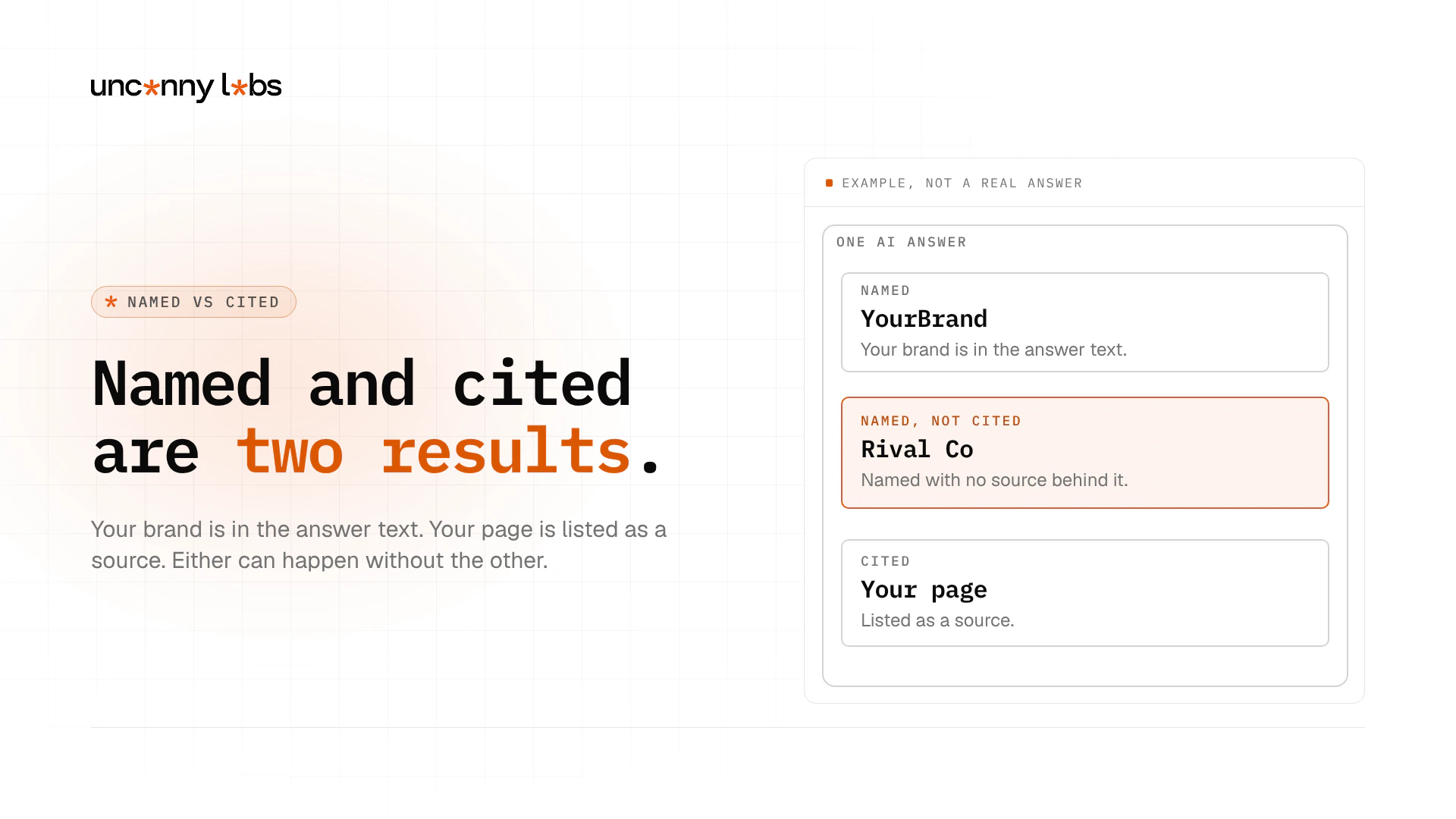
Being named means the AI answer says your brand. Being cited means one of your pages is listed as a source. They're separate results (brand mentions vs citations), and you can get either one without the other.
For founders and marketing leads reading AI-visibility reports, the useful question is which result the report actually measured.
Key takeaways
- Named means your brand is in the answer text. Cited means your page is listed as a source. Either can happen alone (Toronto preprint).
- In one US consumer market, 46% of unprompted brand mentions by a small ChatGPT API model had no cited page naming that brand. This is a preprint, not peer reviewed (Chen and Koudas).
- In that study, every page ChatGPT cited had been retrieved by its own search. That finding is about the studied API setup, not a guarantee for every engine (paper).
- Google Search and OpenAI's API together recovered about 26-28% of the exact pages ChatGPT cited, and about half the sites, in two tested settings (Jiang et al., preprint, not peer reviewed).
- Google's and Bing's AI reports measure links and citations, not brand naming. Record named and cited separately over repeated runs (Google, Bing).
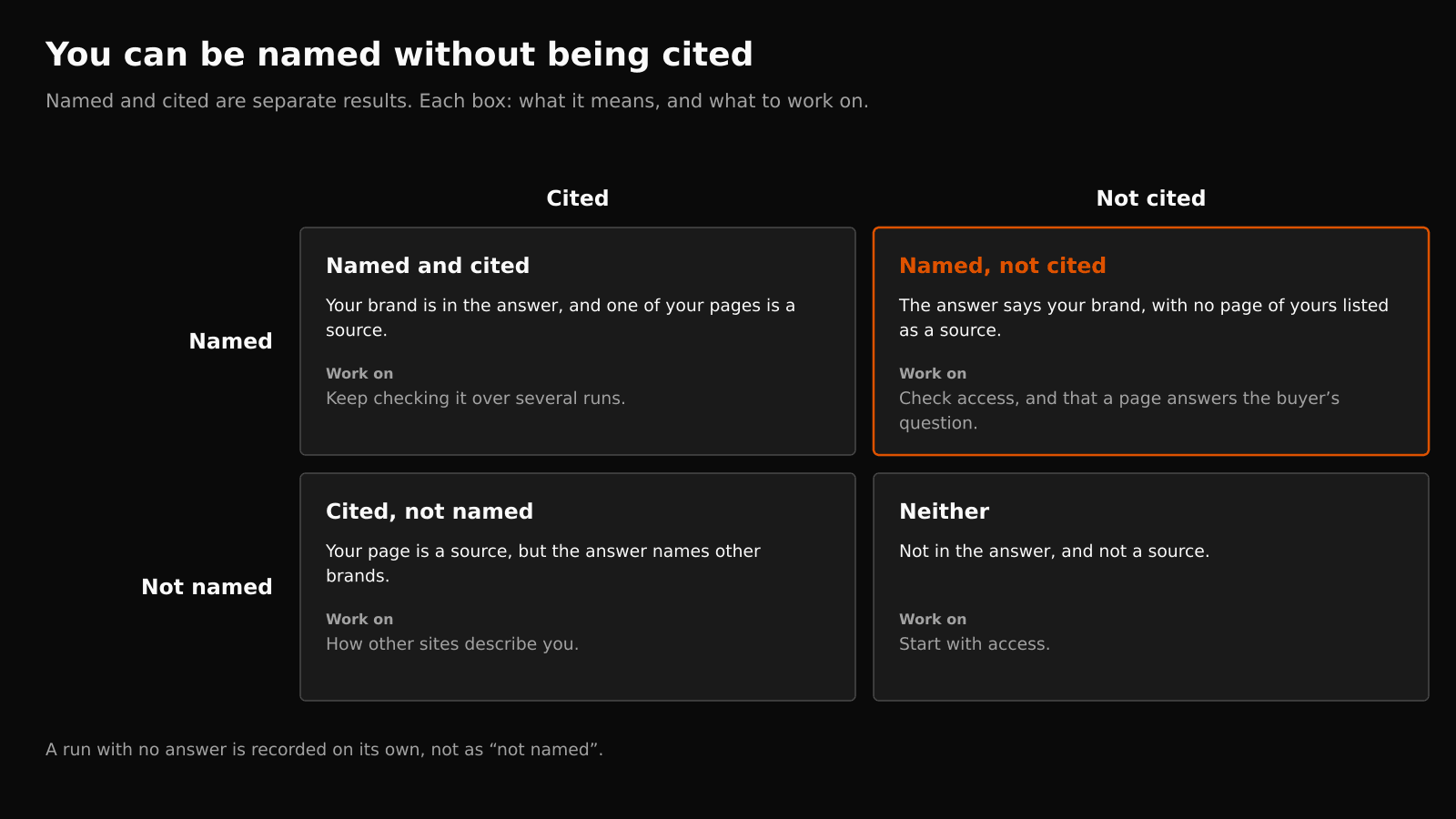
Named vs cited: two different results
What is AI visibility? treats them as two separate outcomes:
- Will they cite it? One of your pages is listed as a source for the answer.
- Do they name you? Your brand is in the answer text.
Table 1. Named and cited are two results
| Row | Cited | Not cited |
|---|---|---|
| Named | Named and cited | Named only |
| Not named | Cited only | Neither |
Some runs give no answer at all: the AI tool didn't answer the question. Record that as "no answer", on its own. It isn't "not named".
There's also a third win, getting picked, where the buyer or their agent acts.
In one paragraph: Named and cited are two results, not one. An answer can list your page as a source and recommend other brands, or say your brand with no page of yours behind it. In a University of Toronto preprint, not peer reviewed, 46% of the times a small ChatGPT API model named a brand the question hadn't named, none of its cited pages named that brand; the figure comes from one US consumer market (Chen and Koudas).
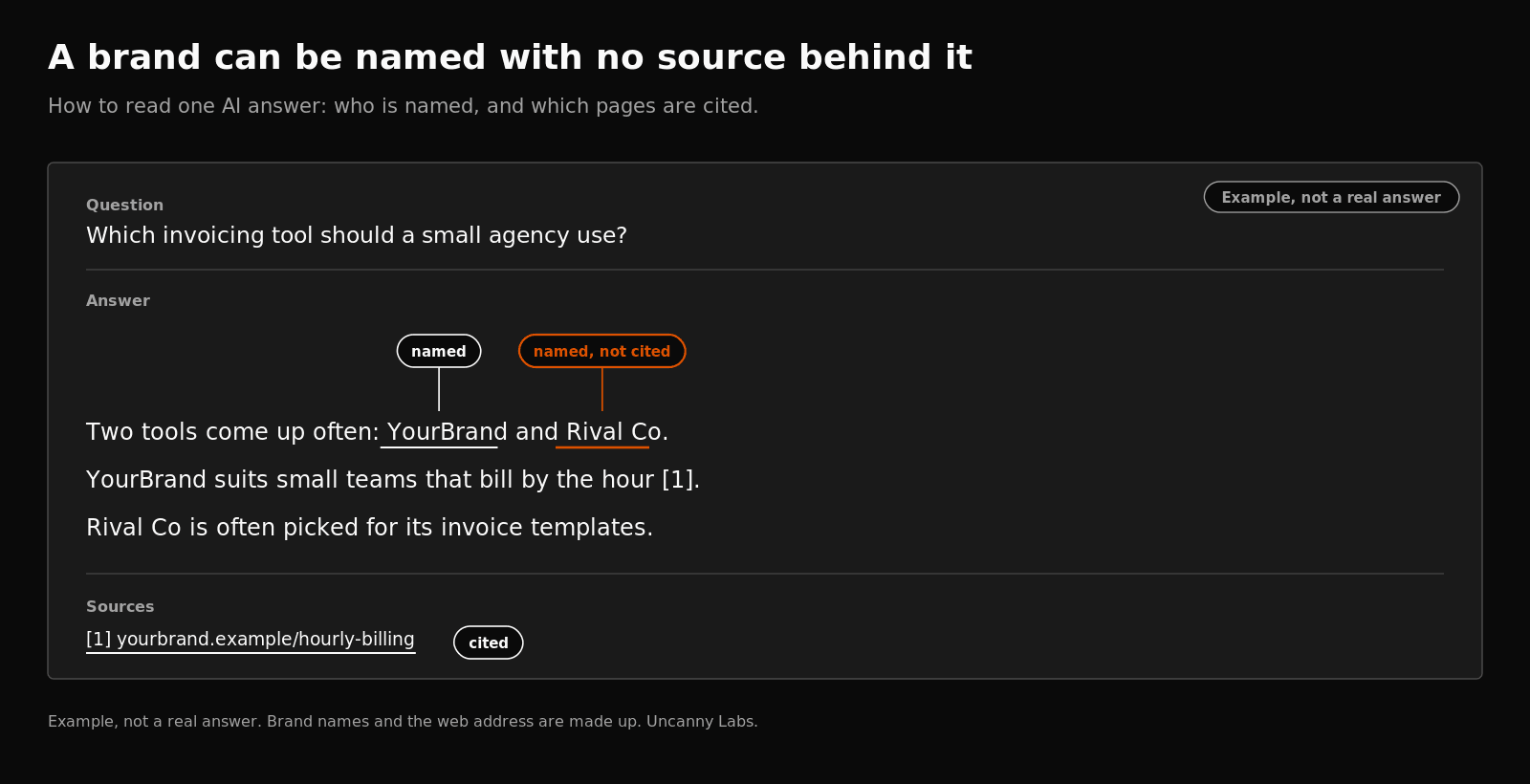
Why AI answers name brands they don't cite
The model already knows some brands from its training. It can name them with no page behind them.
How often? In one study, 46% of the times a small ChatGPT API model named a brand the question hadn't named, none of its cited pages named that brand. The study is a University of Toronto preprint, not peer reviewed, and the figure comes from one US consumer market (Chen & Koudas, Oct 2026).
What that means for you: being named depends heavily on how the rest of the web talks about you. See what other sites say about you.
For Google specifically, its optimization guidance describes using information across blogs, videos and forum discussions. It also warns against seeking inauthentic mentions. That is not a promise that any placement will produce AI brand mentions.
Off-site evidence: forums, lists, coverage and web mentions
These are off-site, guidance-only actions, not checks one owned URL can pass. Separate being named, cited and recommended for the particular prompt and engine. Google warns against inauthentic mentions; these labels do not justify manufactured placements.
Forum and thread presence
Mixed. Answer real questions where buyers participate; avoid drive-by links. Profound's August 2024–June 2025 corpus shows different citation patterns across platforms. Its share of citations, or a share within top sources, is not the effect of posting. Searching for brand threads is only a limited proxy, not proof your business has mentions.
Third-party lists and comparisons
Supported listing label; guidance only. Look at relevant independent shortlists and how they describe the business. Ahrefs' recommendation-prompt study observed lists and third-party positioning in a bounded vendor study, not an outreach success rate. A comparison pattern in your own title does not verify independent inclusion. Keep earned coverage distinct from self-promotion.
Coverage and reviews
Supported label; guidance only. Inspect publisher and review pages actually cited for relevant prompts, then check whether they name the business accurately. Generic clipping totals cannot answer that question. Obtaining a review or article does not guarantee that an engine will cite it or recommend you.
Wider web and YouTube mentions
Mixed. Ahrefs' cross-platform brand study found mention correlations, with platform differences and a filtered brand sample. It is observational: increasing a mentions metric is not established as a cause of more AI naming. This same evidence informs coverage and backlink discussions; repeating it is not independent replication. An owned-name-consistency check is not a web/YouTube mentions index.
The Toronto preprint discussed above separates retrieval and model knowledge within its studied settings; it does not establish the effect of these four actions. Keep its preprint, model and market limits attached. For site-side diagnosis, use access and firewall checks, content in the initial HTML and match a buyer question. These do not replace the named/cited grid or its separate no-answer category.
Why your page can be cited without your brand being named
The engine can use your page as a source for a fact or a definition, then name other brands in the answer.
Being cited starts with the engine's own search returning your page. A University of Toronto preprint found that for ChatGPT, which pages its own search retrieves explains far more of the citation differences than page features do (details).
So work on being found: retrieval and fan-out, and titles and paragraphs that match the question. These LLM citations show that the page was selected as a source; they do not establish that the answer recommended the business behind it. Google's AI features documentation likewise describes links to supporting websites, not a brand-endorsement measure.
Which one to work on first
It depends on where you are. Nobody can promise a result.
- Cited, not named? Your page is being used as a source. Work on how other sites describe you.
- Named, not cited? Check your robots.txt and firewall rules for AI search crawlers, and make sure your main content is in the HTML. See AI bot access and server-rendered main content. Then check that a page answers the buyer's question.
- Neither? Start with access, then check the page against the question.
Access rules differ by provider and purpose. OpenAI separates search crawling from training; Perplexity recommends allowing its search bot and published IP ranges; Anthropic distinguishes search and user-directed fetching from training. Check the relevant controls rather than assuming one rule covers every visit. Access is a diagnostic starting point, not an absolute explanation of every citation observed in an answer.
Use the grid per question and engine before summarizing the whole report. If a page is cited for an explanatory question but the brand is absent from a buying question, keep those observations separate. Inspect the question where naming is missing before changing a page that already serves as a source. This avoids treating different questions as a single failure to fix.
Why trackers and the ChatGPT app disagree
Tools sample answers, often through APIs. Those answers can differ from what the app shows.
A 2026 preprint from Xi'an Jiaotong University and the National University of Singapore, not peer reviewed, used 80 questions, each run 20 times in the two settings behind this comparison. It found that Google results and OpenAI's API together found only about 26-28% of the exact pages ChatGPT cited, and about half of the sites.
Two habits help:
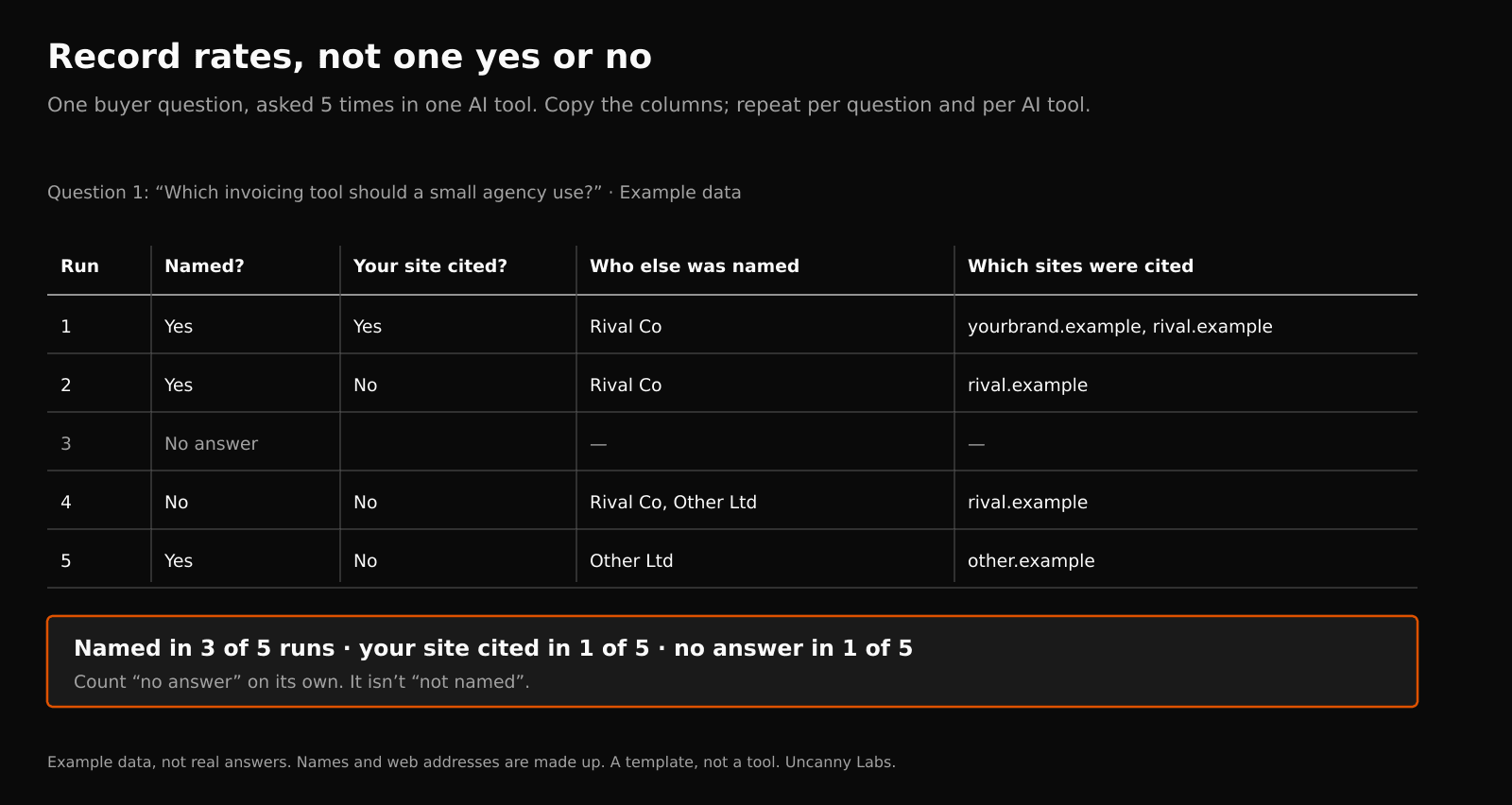
- Record rates, not one yes or no. Answers change from run to run. Write "named in 3 of 5 runs", as an example, not a benchmark. Use the receipt test for any AI visibility number.
- Compare sites, not only exact pages. In that paper, proxies matched about half the sites but far fewer exact pages. Keep exact URLs in the record when page-level citation is the question.
For AI citation tracking, ask which surface was sampled. A tracker result is evidence about that sample, not a reproduction of every answer a buyer could see in the app.
An exact-page mismatch and a missing brand are different checks. If a proxy finds another page on your domain, it has not reproduced the app's citation, but it also has not shown that the domain was absent. Save the app's source URL alongside the proxy result so the difference remains inspectable (Jiang et al.).
How to check both yourself
- Write a fixed list of buyer questions.
- Ask each one several times in each AI tool.
- For each run, record four things: named (yes or no), your site cited (yes or no), who else was named, and which sites were cited.
- Mark "no answer" runs on their own.
Save the answer text with the tally. Check brand naming in the answer itself and page citation in its sources, rather than inferring either result from the other column. Keep no-answer runs visible when calculating rates.
For writing good questions, see how to test your brand in ChatGPT. For Perplexity, see getting cited by Perplexity.
A named answer with no click won't show in your analytics either.
What Google's and Bing's AI reports can and can't show: Google Search Console's generative AI report counts impressions of links to your site in AI Overviews and AI Mode, with a page dimension. Bing Webmaster Tools' AI Performance shows citation counts, cited URLs and sampled grounding queries across its supported AI experiences. Neither is a record of whether an answer named your brand. Use them to find pages to inspect, then review the answer text separately. Don't treat Google's link impressions and Bing's citations as interchangeable units or combine them into a naming rate. See what Google's and Bing's AI reports count for the comparison.
FAQ
Is being named by ChatGPT the same as being cited? No. Named means your brand is in the answer text. Cited means your page is listed as a source. Either can happen without the other.
Why does ChatGPT name my brand with no link to my site? It can name brands it already knows from training. In one study, 46% of the times a small ChatGPT API model named a brand the question hadn't named, none of its cited pages named that brand. That's one preprint, not peer reviewed, and the figure comes from one US consumer market.
Why was my page cited but a competitor named? The engine used your page as a source but named other brands. That can come down to how other sites describe your category.
Does ChatGPT show its sources? Responses that use web search may include citations, according to OpenAI's help page. Select Sources, when available, to view cited sources and other relevant links. Check the cited page itself, because the help page warns that citations can be incomplete, outdated or incorrect.
Why do AI answers only name a few brands? The Toronto preprint, not peer reviewed, studied a small ChatGPT API model, GPT-5.4 nano, in US home internet and a second market of small business-software vendors. In the consumer market, a brand in the model's prior, measured by asking without search, was named with 5.8 times the odds at equal citation support, not 5.8 times the probability. In the second market, covering proposal and business-development software for architecture, engineering and construction firms, the model behind ChatGPT named the tracked vendors without search for only 2-16% of the questions. These are findings from the studied API model and markets, not a limit on how many brands every AI answer can name. See what other sites say about you.
How do I find out which of my pages are cited in AI answers? Bing's AI Performance report lists cited pages and sampled grounding queries. Google's generative AI report shows link impressions by page for AI Overviews and AI Mode, rather than the same citation metric. Neither shows whether your brand was named. Compare what those reports measure, then inspect the answer text.
Can a tool track named and cited for me? Tools sample answers, often through APIs, so their results can differ from the app. Whatever you use, record rates over several runs. Ask it to report named and cited separately, per engine, with dates and run counts. Apply the receipt test before comparing numbers.
Bottom line
Named and cited are separate results. Being cited and being named need separate records, even when they occur in the same answer. Count both, as rates over several runs, on Layer 3 of the 4-layer stack.
Sources
- Chen and Koudas, University of Toronto. What Drives AI Citations?. Preprint, not peer reviewed.
- Jiang et al. Understanding ChatGPT Citations. Preprint, not peer reviewed.
- Google Search Console Help. Generative AI performance report.
- Bing Webmaster Blog. Introducing AI Performance.
- Google Search Central. AI features and your website.
- Google Search Central. Optimizing for generative AI features.
- OpenAI. Overview of OpenAI crawlers.
- OpenAI Help Center. Searching the web with ChatGPT.
- Perplexity. Perplexity crawlers.
- Anthropic. Crawlers and site-owner controls.
Related resources
- Guide
What is AI visibility?
A plain definition of AI visibility, mapped to SEO, AEO and GEO, and how to judge any score you see.
- Article
SEO vs AEO vs GEO
What Google says, what changes in ChatGPT and AI Overviews, a 4-layer stack, and how to measure each one.
- Research
Agent ready vs AI visibility
Does your site work for AI agents, and do AI answers name you? Two questions, two different checks.
- Guide
How to measure AI traffic
ChatGPT's UTM tag, a GA4 channel, Search Console and Bing, and what none of them can see.