Agent ready vs AI visibility: does your site work for AI agents, and do AI answers name you?
Agent ready: is your site built so AI agents can read and use it? AI visibility: do ChatGPT, Perplexity and AI Overviews name or cite you? How they differ.
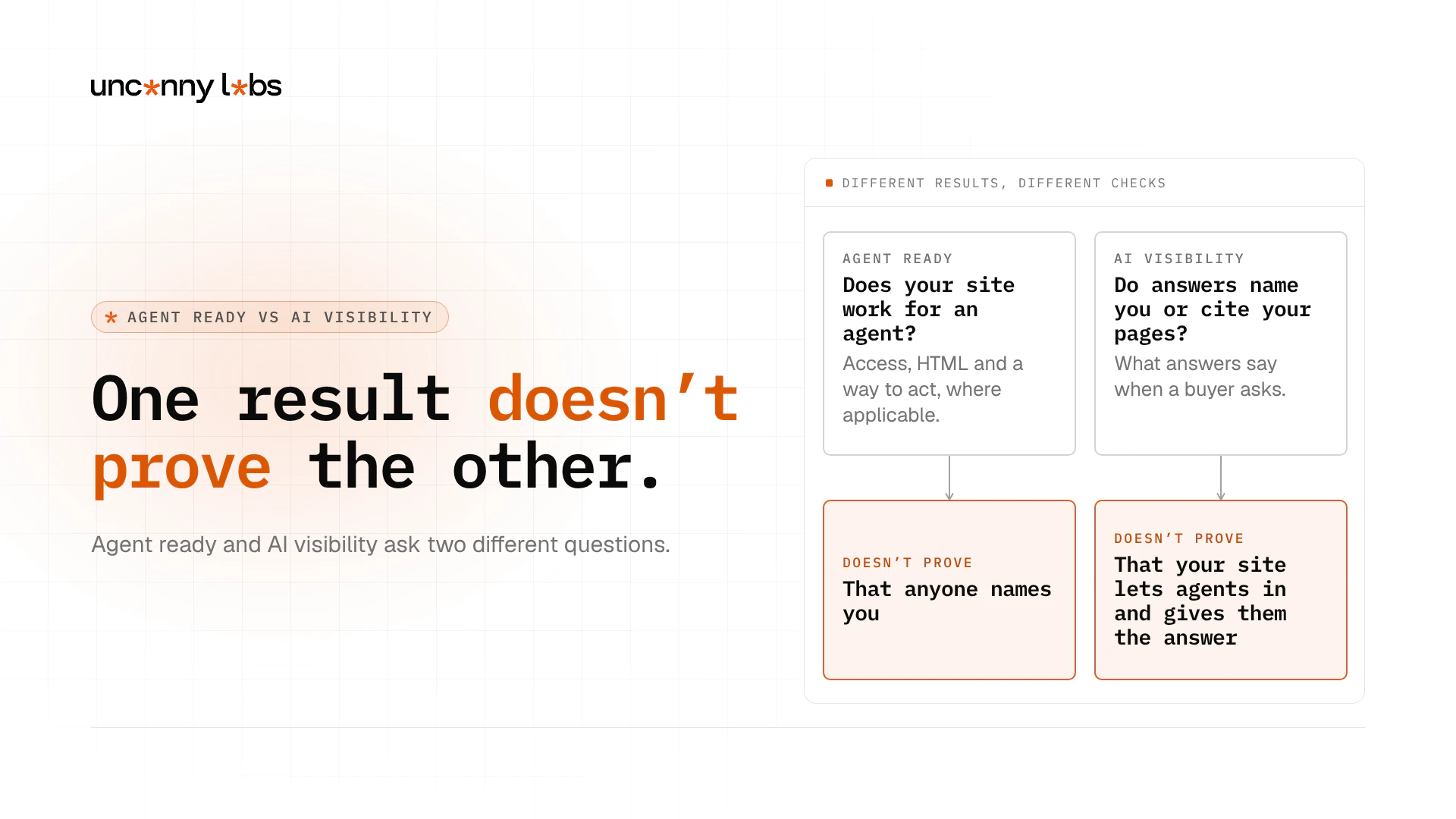
"Agent ready" means your site lets AI agents in, puts its answers in the page's HTML and, where tasks apply, gives them a way to act. "AI visibility" means AI answers name your brand or cite your pages when buyers ask. They're different results with different causes, and a score for one doesn't tell you the other.
For founders, marketers and web leads comparing a readiness audit with an AI-visibility report, the distinction is what evidence to ask for. See the agent-ready layer of the stack for its place alongside search and brand naming.
Key takeaways
- AI visibility vs AI agent readiness: the first checks what answers say; the second checks whether an agent can read and, where applicable, act on your site.
- The open AgentReady spec lets purely informational sites conform on find/read alone.
- A readiness score doesn't show whether you were named or cited. Keep the comparison table's two questions separate.
- Ora's vendor-research preprint, not peer reviewed, gave every agent the domain in its prompt. It doesn't test whether a buyer's question would first surface that business.
- Record readiness checks and named/cited rates separately; the pillar's scoreboard puts both on one page.
What does "agent ready" mean?
AI agents are the assistants and tools that fetch pages and act for a person, from ChatGPT and Perplexity to coding and shopping agents. An agent-ready website is one built for these tools to fetch and act on, when tasks apply.
AgentReady is an open, MIT-licensed specification written by ora.ai and Vercel for sites that agents need to find, read and act on (source). It requires access to public content, answers in the initial HTML and honest status codes for every applicable site, while an action interface applies only to products agents are expected to act on.
A purely informational site conforms on find/read alone; it does not need a transaction flow just to publish useful answers. Conformance describes the applicable requirements, not a visibility score or evidence that an answer named the business. For implementation detail, see the AgentReady spec's four MUSTs and which requirements apply to your site.
For a shop, readiness can include comparing products and completing checkout; for an informational site, find/read is enough. A booking service has a task to test when agents are expected to complete bookings.
Agent readiness, agent experience (AX) and readiness scores
Agent experience (AX) describes how a product works for an AI agent. A readiness score can suggest what to inspect; it doesn't show whether AI answers name or cite you. The spec and the scores are different: requirements define conformance, while scoring tools choose weights.
What does "AI visibility" mean?
AI visibility includes two results to keep apart:
- Named: your brand is in the answer text.
- Cited: your page is listed as a source.
The Toronto preprint, not peer reviewed, found that model knowledge and retrieved evidence both shaped naming. That is a different question from whether an agent can fetch your page. See why an answer can name you without citing your site. A readiness audit cannot replace a record of the answers themselves.
Agent ready vs AI visibility, side by side
Table 1. AI visibility vs AI agent readiness: different results, different checks
| Row | Agent ready | AI visibility |
|---|---|---|
| The question | Does your site let AI agents in, give them the answer in its HTML and, if needed, a way to act? | Do ChatGPT and Perplexity, or Google's AI Overviews, name you or cite your pages? |
| What it checks | Access and usability when an agent attempts a visit, whether reached through discovery or given a URL | What answers say when a buyer asks about your category, often without naming you |
| What mostly decides it | Your own site: access, HTML, error codes and a way to act, where applicable | What the engines already know about you, other sites that name you (reviews, comparisons, press, forums), and pages that match the buyer's question |
| Who controls it | You, mostly | Partly you; much of it sits with other sites and the engines themselves |
| How to check | A readiness scanner, or a test visit as an AI crawler, plus a task test where applicable | Ask the engines real buyer questions and record named vs cited |
| What a good result doesn't prove | That anyone names you | That your site lets AI agents in and gives them the answer |
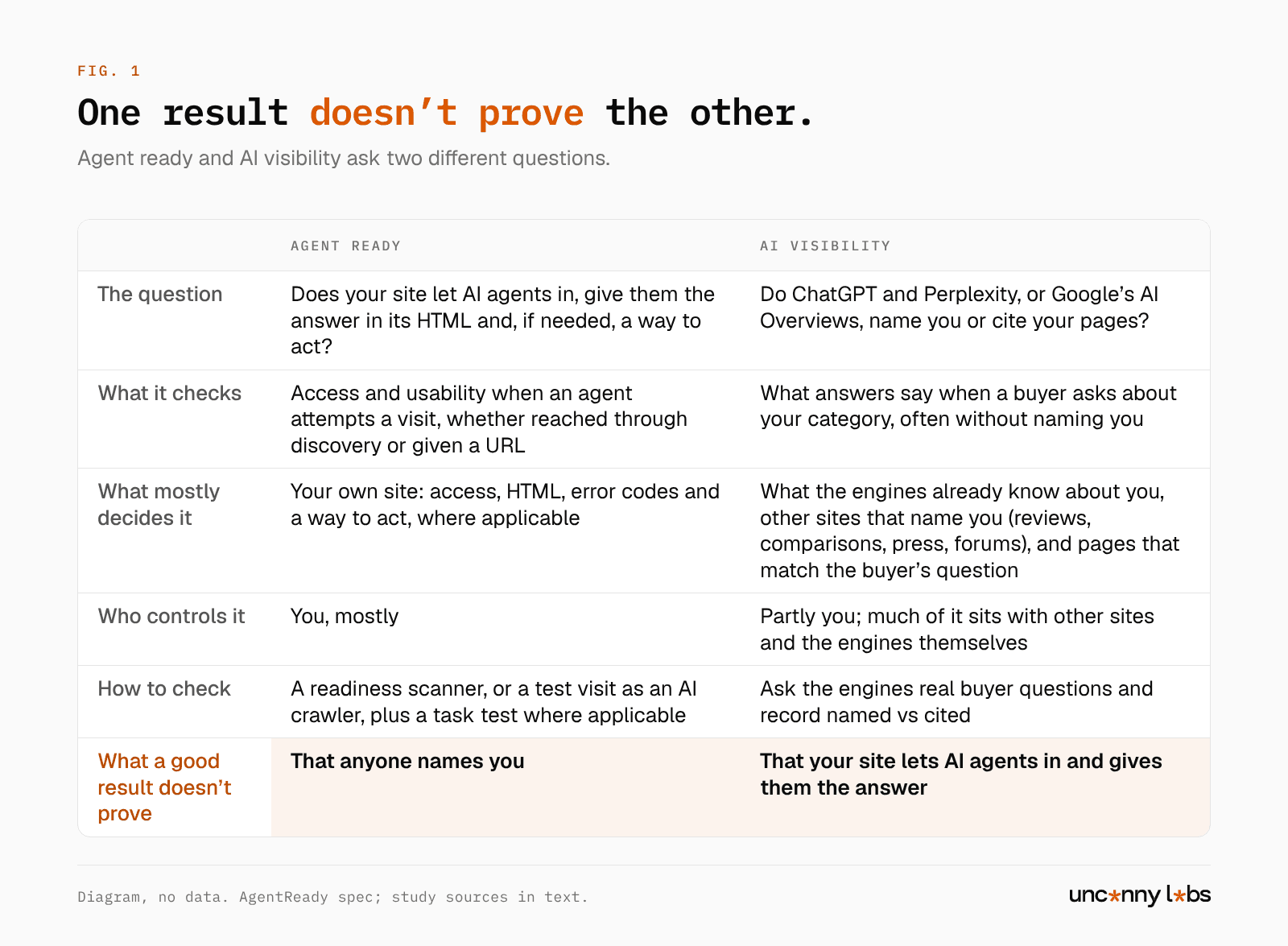
In one paragraph: A good readiness result doesn't prove an AI answer will name or cite you. A named answer doesn't prove an agent can use your site. Access and readable content help both, but the two results need separate checks (AgentReady spec; Toronto preprint, not peer reviewed).
Use the table to ask for the missing evidence. If a report shows only that an agent fetched a page, ask for the answers before drawing a visibility conclusion. If it shows the brand in an answer, ask separately whether the agent could read the intended page or finish the relevant task. A source link is evidence of citation in that answer; it is not a transaction test. These distinctions also help assign work: an access repair addresses the observed site failure, while a missing mention still needs an answer-level diagnosis.
What Ora's research shows, and what it can't
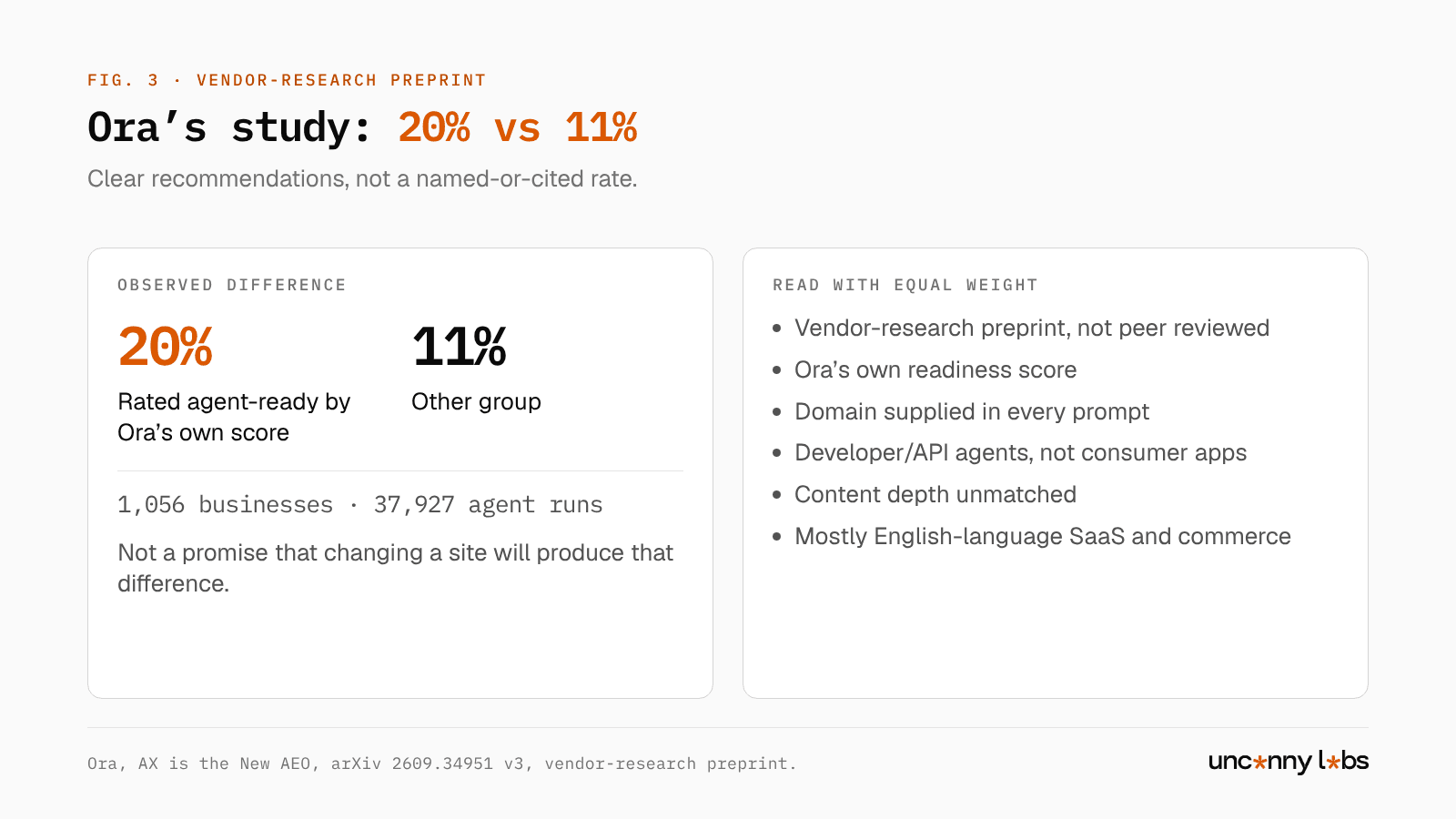
The study is "AX is the New AEO" by Ora's own researchers. It's vendor research and a preprint, not peer reviewed.
In Ora's study of 1,056 businesses and 37,927 agent runs, answers clearly recommended businesses that Ora's own score rated agent-ready 20% of the time, against 11% for the rest (paper, recommendation results). The result is an observed difference between groups, not a promise that changing a site will produce that difference.
The limits matter just as much as the result:
- Every prompt already contained the business's domain. The study measured answers after the agent was told which site to consider, not whether the business would be discovered from an unbranded category question.
- The agents ran in developer and API tools: claude-code, claude-agent-sdk, openclaw and eve. They were not the ChatGPT or Perplexity consumer apps.
- Groups were split using the accessibility layer of Ora's own readiness score. That study label is not an independent certification or the same thing as passing every applicable AgentReady requirement.
- Content depth was not matched between groups. Businesses were mostly English-language SaaS and commerce, which limits how broadly the result can be applied.
Ora's recommendation outcome required agreement from both judges at the top rating. It was not a count of every neutral mention or citation. An answer that names a business without clearly endorsing it would not mean the same thing as the study's recommendation outcome. That difference is why its headline should not be substituted for a named-or-cited visibility rate (paper, measures).
The researchers matched groups on fame, prior model knowledge and their measures of AEO. That helps describe the comparison, but does not remove the unmatched content-depth limitation. Reading the paper's own definition of "agent-ready" is essential before comparing the result with a different audit.
The Toronto preprint asked a different question: which pages were cited and which brands were named in the studied answers. Ora supplied the domain before the journey began. Neither study establishes that a readiness score predicts discovery in consumer AI apps, and one is not a test of the other.
The basics that help both
Access, readable content and truthful status codes are the shared starting point, not a guarantee of naming (AgentReady; Vercel's returned-HTML guidance). Check AI bot access, firewall and CDN rules and server-rendered main content. Keep crawl policy separate from actual access: RFC 9309 says robots rules are not authorization, while OpenAI's crawler documentation separates search crawling, training and user-directed visits.
What to do first
- Check readiness on the site. Inspect a real response, not just a score: can the intended agent get in, is the answer in the returned HTML, and do missing pages return honest error codes? If agents should complete booking or checkout, test that task too. web.dev's agent UX guidance explains why semantic controls and stable layouts matter for interaction. Use which requirements apply to your site to set the test's scope.
- Check visibility in answers. Keep a fixed set of buyer questions, repeat them per engine, and record named and cited separately, with dates, run counts and no-answer runs. Use the pillar's scoreboard to keep these answer results beside the site checks, without merging them into one score.
Keep the evidence from each track together: the tested page and observed response for readiness, and the exact prompt and saved answer for visibility. After a repair, repeat the relevant check rather than treating a changed readiness score as proof that buyer-facing answers changed too.
FAQ
What does agent ready mean? Your site lets AI agents in, puts its answers in the HTML and, if agents should finish a task with you, gives them a way to act. It's about your site working for AI agents, not whether AI answers name you.
Is agent ready the same as AI visibility? No. Agent ready is about your site working for AI agents. AI visibility is about ChatGPT and Perplexity, or Google's AI Overviews, naming you or citing your pages. You can have one without the other.
What is agent experience (AX)? Agent experience (AX) describes how well a product or platform works for an AI agent, as Mathias Biilmann introduced the term. See what AX means in the spec discussion for the distinction from a readiness score.
How do I check if my site is agent-ready? Check access, the answer in the initial HTML and honest status codes, then test a task if agents are expected to act. Use the spec's checking guide to compare observed responses with the applicable requirements.
Does llms.txt make my site agent ready? No: the AgentReady spec rates it SHOULD, not MUST, so its presence does not establish conformance or prove naming. See does AgentReady require llms.txt?; adding the file is not evidence that AI answers will name the brand.
Do I need an MCP server? The spec's action-interface requirement applies only where agents are expected to act, and permits an MCP server or a CLI. Purely informational sites conform on find/read alone; see which requirements apply.
Will being agent ready get my brand named by ChatGPT? No one can promise that. Ora's vendor-research preprint, not peer reviewed, only tested agents already told the domain. The Toronto preprint, also not peer reviewed, found naming depended on model knowledge and retrieved evidence, which a site audit alone does not measure.
What does agent-ready mean in ecommerce? Agents need to reach and read product information and, when expected to act, complete the relevant task, such as checkout. That doesn't guarantee a mention or recommendation in an AI answer. See which requirements apply to your site.
Bottom line
A readiness check and an answer record provide different evidence. Keep both: the agent-ready layer of the stack covers site usability, while how to judge an AI visibility number explains what an answer-based result needs to show.
Sources
- AgentReady. Specification v2.0.1, written by ora.ai and Vercel, MIT licence.
- Finder, Elovic, Shalev and Yosef (Ora). AX is the New AEO, v3, vendor-research preprint, not peer reviewed.
- Mathias Biilmann. Introducing AX: Why Agent Experience Matters.
- Chen and Koudas, University of Toronto. What Drives AI Citations?. Preprint, not peer reviewed.
- Vercel. Make your site readable by AI agents.
- web.dev. AI agent site UX.
- RFC Editor. RFC 9309: Robots Exclusion Protocol.
- OpenAI. Overview of OpenAI crawlers.
Related resources
- Article
The AgentReady spec
What the open AgentReady spec (v2.0) requires: find, read and act, and which practices apply to your site.
- Guide
What is AI visibility?
A plain definition of AI visibility, mapped to SEO, AEO and GEO, and how to judge any score you see.
- Article
SEO vs AEO vs GEO
What Google says, what changes in ChatGPT and AI Overviews, a 4-layer stack, and how to measure each one.
- Guide
Named vs cited
Why AI answers can name your brand without citing your site, and how to check both.