The AgentReady Spec: Find, Read and Act
What the open AgentReady spec (v2.0) requires: the four MUSTs, every AR-FIND, AR-READ and AR-ACT practice, and which ones your kind of site needs.
What the open agent-readiness standard (v2.0, October 2026) actually requires, practice by practice, and which parts apply to your site.
AgentReady is an open, MIT-licensed spec, written by ora.ai and Vercel, that lists what a site must do so AI agents can find it, read it and, if they should finish a task there, act on it. Version 2.0 (October 2026) has just four MUSTs, and a site that only informs needs three of them. It names what to implement. It doesn't score anyone.
Key takeaways
- AgentReady v2.0 has four MUSTs: AR-FIND-01, AR-READ-01, AR-READ-02 and AR-ACT-10 (spec.md).
- A purely informational site conforms on the find and read requirements alone (spec "Conformance").
- In Ora's controlled test, only two kinds of change across 19 configurations stopped retrieval: answer only in JavaScript, and a 403 to agent user agents (Ora).
- llms.txt is a SHOULD (AR-READ-07). Markdown mirrors are a MAY (AR-READ-09).
- Readiness is a floor. It doesn't decide whether AI answers name the business.
What is AgentReady?
AgentReady is an open specification, published at agentready.org and developed on GitHub under the MIT license, that defines what a site or product should implement so AI agents can use it. It doesn't invent a protocol. It "composes existing, real standards" such as robots.txt, sitemaps, llms.txt, OpenAPI, OAuth and MCP.
Ora announced it on 19 October 2026 as "the first open standard for AX".
Its non-goals: scoring, a new manifest format, and defining how agents are built.
What "agent experience" (AX) means here
Ora's paper defines agent experience (AX) as whether an agent "can fetch and read the business's own site".
How is the spec organized?
The spec follows the order agents meet a site: find, then read, then act, and "each stage depends on the previous one." Every requirement has a level (MUST, SHOULD or MAY, as defined in RFC 2119 and RFC 8174) and a stable ID that is never reused.
The spec says "normative weight is derived from measurement":
- MUST: what agents failed without (Table 1).
- SHOULD: practices that "measurably shaped where agents went", or that make acting reliable.
- MAY: "emerging conventions with early but unquantified adoption."
Numbers carry a source tag. [STUDIES] is Ora's research: more than 250,000 agent runs, a published subset of 1,033 traced runs across 25 sites, and a controlled experiment. [ORA SCANNER] is Ora's reachability checks.
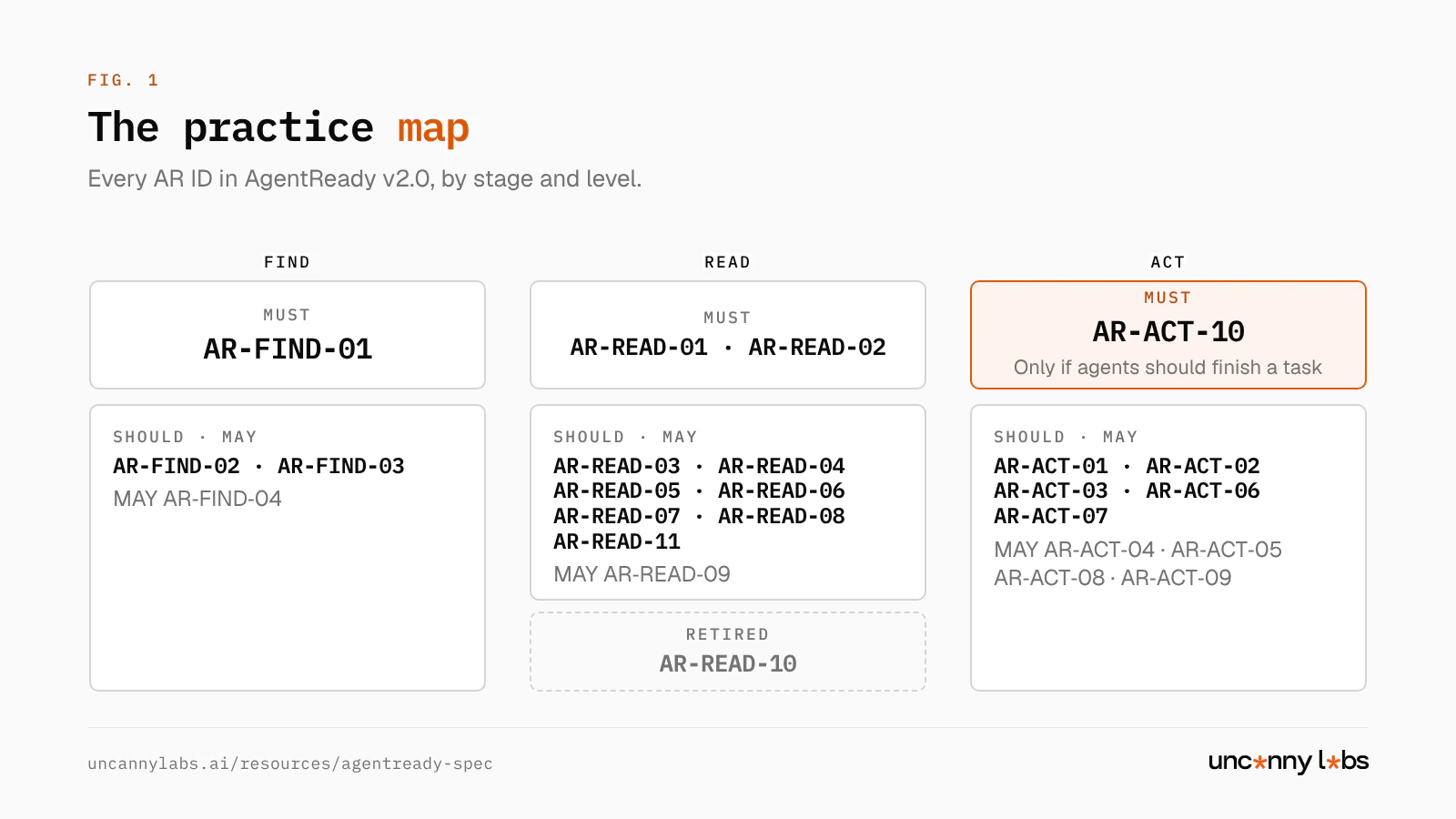
Fig. 1. The practice map.
What are the four MUSTs?
AgentReady v2.0 has four MUSTs: don't block agents (AR-FIND-01), put the answer in the initial HTML (AR-READ-01), return honest status codes (AR-READ-02) and, only for products agents act on, offer an MCP server or a CLI (AR-ACT-10). In the spec's words: "only two changes caused agents to fail outright: hiding answers behind JavaScript and blocking access."
Table 1. The four MUSTs in AgentReady v2.0
| ID | In plain words | Applies to | Spec evidence | How to check |
|---|---|---|---|---|
| AR-FIND-01 | Don't block agents, in robots.txt or at the firewall | Every site | Blocking broke agents | Agent requests get a 200 in server logs |
| AR-READ-01 | Answer in the initial HTML | Every site | A JavaScript-hidden answer broke agents | View source shows the answer |
| AR-READ-02 | 404 for missing pages; 429 with Retry-After when throttling | Every site | Agents can't tell a soft 404 from a live page | A made-up URL returns 404 |
| AR-ACT-10 | An MCP server or a CLI | Products agents act on | Agents need an interface to act through | An agent completes your main task |
AR-FIND-01: don't block agents
Two gates count: robots.txt (RFC 9309) and bot protection. A firewall that answers agents "with a 403 or a challenge page blocks them however permissive the file is".
AR-READ-01: answer in the initial HTML
The answer must be "server-rendered or prerendered, not injected by a single-page app after load".
AR-READ-02: honest status codes
A missing page returns 404 or a valid redirect, never 200. The spec cites a single-page app that "returned 200 for every path, making dead URLs appear valid".
AR-ACT-10: an MCP server or a CLI
It applies only to "a product agents are expected to act on", and the spec warns: "do not ship an empty surface to meet the requirement."
Find: be reachable and citable (AR-FIND-01 to 04)
The find stage has one MUST, two SHOULDs and one MAY. Blocked pages, the spec says, "are absent rather than ranked lower."
Table 2a. Find practices
| ID | Level | In plain words | Applies to |
|---|---|---|---|
| AR-FIND-01 | MUST | Don't block agent and crawler access | Every site |
| AR-FIND-02 | SHOULD | Answers agents will cite on one canonical, first-party docs page | Every site |
| AR-FIND-03 | SHOULD | sitemap.xml referenced from robots.txt | Every site |
| AR-FIND-04 | MAY | AI Catalog at /.well-known/ai-catalog.json | Sites with agent-facing resources |
The spec recommends one wildcard robots.txt rule, not an allowlist. It separates three crawler jobs: training, search index and user-initiated. A site MAY block training crawlers without leaving search indexes. OpenAI says sites opted out of OAI-SearchBot "will not be shown in ChatGPT search answers". The pillar keeps a full crawler table.
Read: put the answer where agents read (AR-READ-01 to 11)
The read stage asks whether an agent can extract the answer from the returned page. It has two MUSTs, seven SHOULDs and one MAY. Per the spec, "agents used the same homepage and docs pages as human visitors"; agent-specific files only help them reach those answers.
Table 2b. Read practices
| ID | Level | In plain words | Applies to |
|---|---|---|---|
| AR-READ-01 | MUST | Answer in the initial HTML | Every site |
| AR-READ-02 | MUST | Accurate status codes | Every site |
| AR-READ-03 | SHOULD | Raw HTML homepage linking docs, product, pricing | Every site |
| AR-READ-04 | SHOULD | Docs answer the tasks users bring to agents | Sites with docs |
| AR-READ-05 | SHOULD | Code fenced and language-tagged | Sites with code |
| AR-READ-06 | SHOULD | Discovery files linked from visited pages | Every site |
| AR-READ-07 | SHOULD | An llms.txt index of key pages | Every site |
| AR-READ-08 | SHOULD | JSON-LD, with critical facts also in visible text | Every site |
| AR-READ-09 | MAY | A markdown mirror | Every site |
| AR-READ-11 | SHOULD | Pricing as text on a first-party page | Sites that charge |
AR-READ-10 (AGENTS.md / SKILLS.md) was removed in August 2026; its ID is retired.
On llms.txt. In Ora's controlled test, configurations with llms.txt, JSON-LD, sitemaps or markdown mirrors made no measurable difference: the answer was retrieved 5/5 either way (Ora).
Act: only if agents should finish a task with you (AR-ACT-01 to 10)
The act stage applies only to products agents are expected to act on. It has one MUST, five SHOULDs and four MAYs.
Table 2c. Act practices
| ID | Level | In plain words | Applies to |
|---|---|---|---|
| AR-ACT-01 | SHOULD | Auth an agent can complete | Products agents act on |
| AR-ACT-02 | SHOULD | Public API described by OpenAPI | Products with an API |
| AR-ACT-03 | SHOULD | MCP server over Streamable HTTP at /mcp | Products agents act on |
| AR-ACT-04 | MAY | MCP server card | Products with an MCP server |
| AR-ACT-05 | MAY | MCP Apps view | Products with a UI |
| AR-ACT-06 | SHOULD | SDKs and a CLI | Products agents act on |
| AR-ACT-07 | SHOULD | WebMCP tools | Web UIs agents should operate |
| AR-ACT-08 | MAY | Agent payments: x402 or MPP per call, UCP or ACP at checkout | Products that charge |
| AR-ACT-09 | MAY | NLWeb /ask endpoint | Content-heavy sites |
| AR-ACT-10 | MUST | An MCP server or a CLI | Products agents act on |
MCP is an open protocol and WebMCP a W3C Community Group draft. Google calls UCP an open standard for agentic buying in AI Mode and Gemini. For the wider field, see other early agent standards.
Which parts apply to your site?
Read AgentReady by what your site is for: a Floor of three MUSTs every site needs, a Fit only products agents act on need, and Extras for the rest.
Table 3a. Floor, Fit, Extras
| Tier | What's in it | Who needs it | The test |
|---|---|---|---|
| Floor | AR-FIND-01, AR-READ-01, AR-READ-02 | Every site | A no-JavaScript fetch with a crawler user agent gets the answer; a made-up URL returns 404 |
| Fit | AR-ACT-10 plus the act SHOULDs that match your product | Products agents act on | An agent finishes your main task |
| Extras | Remaining SHOULDs and MAYs | Every site, after the floor | Each maps to an AR ID |
This follows the conformance rule: "a purely informational site conforms on AR-FIND-* and AR-READ-* alone."
Table 3b. What applies, by site type
| Site type | Floor | Fit | Extras with measured backing |
|---|---|---|---|
| Content or local service | FIND-01, READ-01, READ-02 | Not required | FIND-02, READ-03 |
| Docs-heavy SaaS | Same | ACT-10 if agents integrate it | FIND-02, READ-03, READ-04, READ-05, READ-11 |
| Shop | Same | ACT-10 if agents buy; ACT-08 (MAY) | READ-03, READ-11 |
| Product agents act on | Same | ACT-10 plus ACT-01, ACT-02, ACT-03 or ACT-06 | FIND-02, READ-04, READ-11 |
"Measured backing" means the spec attaches a [STUDIES] figure, such as docs reached in 83% of runs (READ-04).
What changed between versions?
In v2.0 (October 2026), AR-ACT-10 added a MUST, so "a product that conformed to v1.0 may not conform to v2.0".
Table 4. AgentReady version history (from the CHANGELOG)
| Version | Date | What changed |
|---|---|---|
| v1.0.0 | April 2026 (announced 20 March) | First version: five topic sections, IDs later retired |
| v1.0 | August 2026 | Restructured into find / read / act; levels assigned from measurement |
| v2.0 | October 2026 | AR-ACT-10 added as MUST; WebMCP raised to SHOULD; new FIND-04, READ-11, ACT-08, ACT-09; FIND-01 covers bot protection; READ-10 retired |
| v2.0.1 | November 2026 | Editorial; no level changes |
What Ora's research found, and how far it goes
The figures behind AgentReady are Ora's own research. Ora co-wrote the spec, runs the studies and runs the ora.ai scanner. The trace dataset is public on GitHub.
Table 5. Ora's figures and caveats
| Figure | What it measured | Source | Caveat |
|---|---|---|---|
| Of 19 configurations, only "answer only in JavaScript" and "403 to agent user agents" stopped retrieval | Two clients pulling a planted answer (190 probes) | Ora | One docs site; retrieval, not citation |
| 37,927 journeys, 1,056 businesses, four harnesses | Buyer questions about a specific business | arXiv; Ora | Agent toolkits (claude-agent-sdk, claude-code, openclaw, eve), not consumer apps |
| Agent-ready businesses clearly recommended 1.9x more often | Two blind judges gave the top grade | arXiv | "Agent-ready" set by Ora's own scoring |
| Web-built answers 3.7x more likely to miss every asked-for fact | Omission | arXiv | Same study |
| Pricing answers 60% accurate from own pages vs 37% elsewhere | Accuracy by source | Ora | Same study |
| 7 to 10% of the answer from training knowledge | Answer provenance | arXiv | Models run August and September 2026 |
| About 1 in 10 sites blocked major AI crawlers; 3% shipped a spec-grade MCP server | Ora scanner, April 2026 (~50,000 sites) | agentready.org; Ora | Snapshot before v2.0 |
| Paying through Stripe Link, agents got 92.3% of test checkouts right | Agent checkouts | spec.md | Test checkouts |
Vercel's hands-on guide draws on the same 1,033 traced runs, with code.
AgentReady scores no one. Who does?
AgentReady has no scores: "There are no weights, thresholds, or badges in the spec," says Ora's launch post. Scoring is left to tools built on it, whose checks can change independently.
The launch post names three public rankers:
- is-agentic.com: built by Ora with Vercel, for content sites.
- ora.ai: Ora's ranker, covering every requirement.
- mintlify.com/score: grades documentation.
Cloudflare's isitagentready.com is a separate scanner with its own checks, launched 17 April 2026.
A score is one tool's checks and weights.
Where the spec stops: agent ready isn't AI visibility
AgentReady covers whether agents can reach, read and act on your site, not whether AI answers name you. In the 4-layer AI visibility stack, it maps to Found, Answered and Picked, and leaves Named out.
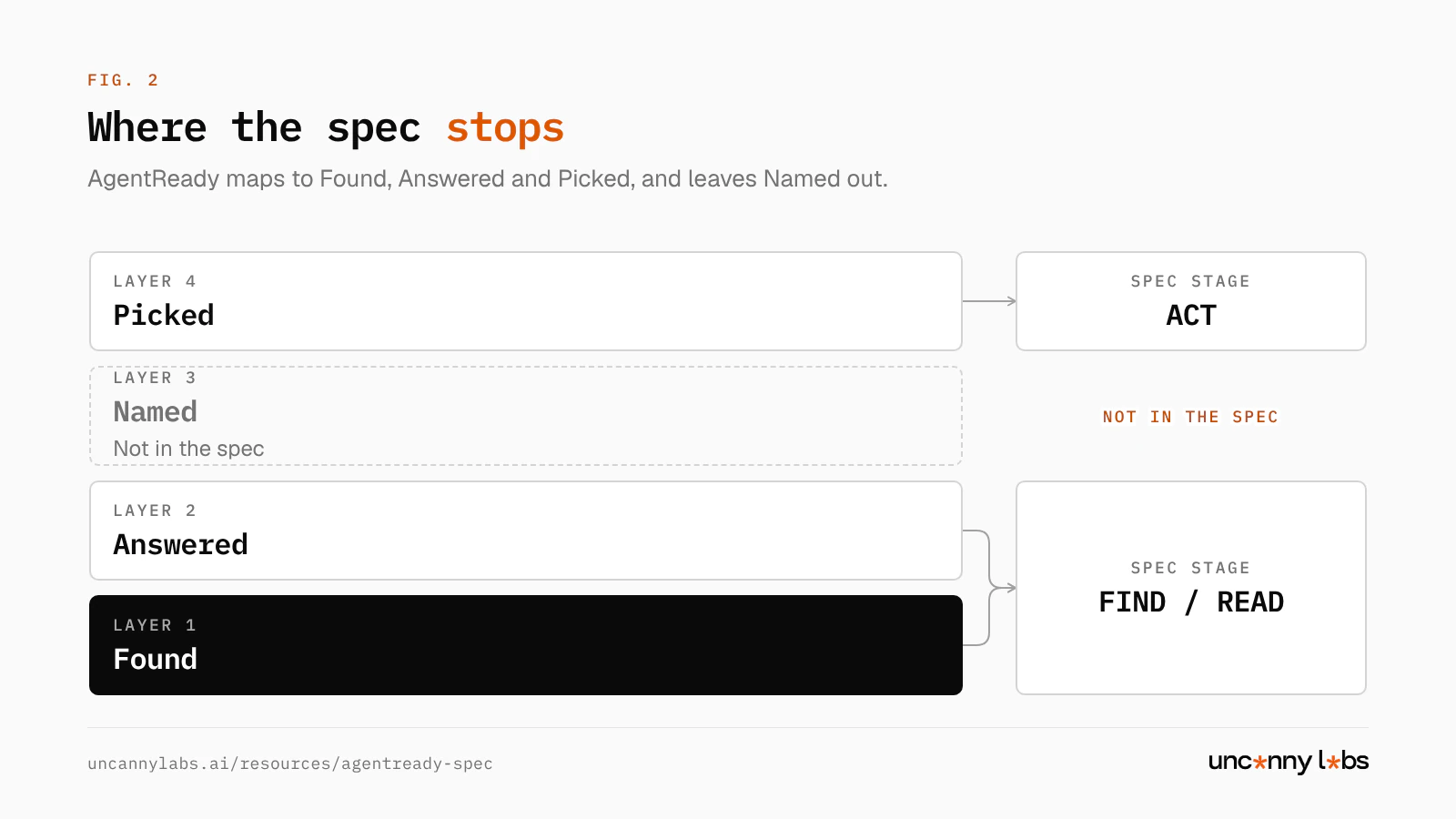
Fig. 2. Where the spec stops.
Table 6. The spec against the 4-layer stack
| Spec stage | Stack layer |
|---|---|
| FIND | 1. Found |
| READ | 1. Found and 2. Answered |
| ACT | 4. Picked |
| (nothing) | 3. Named |
Related: what AI visibility means, named vs cited, agent ready vs AI visibility and the "Picked" layer.
How do you check your site against the spec?
Check the floor first: fetch key pages without JavaScript, request a made-up URL and expect a 404, and confirm agent requests get a 200 in your logs. Then look at the act stage.
- Fetch without JavaScript. The spec's check is
curl -iL -A 'Claude-User/1.0' https://example.com/your-page. It "should end with a 200 response", with the answer in the HTML. - Check robots.txt and the firewall. A group such as
User-agent: GPTBotoverrides*. - Read server logs. The spec says curl "is not proof either way". OpenAI and Anthropic publish crawler IP ranges; confirm those requests return 200.
Public scanners automate similar checks.
FAQ
What is AgentReady.org?
It's the reader site for AgentReady, an open, MIT-licensed spec of what a site should implement for AI agents. It names practices and scores no one.
Is AgentReady vendor-neutral, and who maintains it?
Ora's launch post calls it "vendor neutral, MIT licensed, and developed in the open". It is "Written by: ora.ai and Vercel", lives on GitHub, and Ora runs and publishes the studies behind it.
What are AR-FIND, AR-READ and AR-ACT?
They are the spec's three stages: find, read and act. Each requirement has a stable ID that is never reused.
What does a site need to conform to AgentReady?
Every MUST that applies to it: AR-FIND-01, AR-READ-01, AR-READ-02 and AR-ACT-10. A purely informational site needs only the first three.
Do I need an MCP server to be agent ready?
Only if agents should act on your product. AR-ACT-10 then requires an MCP server or a CLI. A site that only informs needs neither.
Does AgentReady require llms.txt?
No. It's a SHOULD (AR-READ-07), and in Ora's controlled test adding it didn't change whether the answer was retrieved. For citations, see the llms.txt guide.
Does AgentReady give my site a score?
No. The spec has "no weights, thresholds, or badges". Scoring is left to tools such as is-agentic.com, ora.ai and mintlify.com/score.
Will being agent ready get my brand named by ChatGPT?
No one can promise that. AgentReady covers finding, reading and acting on your site, not being named in AI answers; see agent ready vs AI visibility.
Bottom line
AgentReady is a short, open list: four MUSTs, three of them for a site that only informs. Passing means agents can reach and read you, the floor of the 4-layer stack, not a guarantee of being named (agent ready vs AI visibility).
Sources
- AgentReady spec text, v2.0.1 (November 2026): https://github.com/agentready-org/standard/blob/main/spec/spec.md
- AgentReady CHANGELOG: https://github.com/agentready-org/standard/blob/main/CHANGELOG.md
- AgentReady repository and dataset: https://github.com/agentready-org/standard
- AgentReady.org: https://www.agentready.org/
- Ora, "Introducing AgentReady.org: the first open standard for AX" (19 Oct 2026): https://ora.ai/blog/agentready-launch
- Ora, "AX is the New AEO": https://ora.ai/blog/ax-is-the-new-aeo
- Finder, Elovic, Shalev, Yosef, "AX is the New AEO", arXiv:2609.34951 (v3, 6 Oct 2026): https://arxiv.org/abs/2609.34951
- Ora, "The state of agent readiness" (April 2026): https://ora.ai/blog/state-of-agent-readiness-2026
- RFC 2119: https://www.rfc-editor.org/rfc/rfc2119 · RFC 8174: https://www.rfc-editor.org/rfc/rfc8174
- RFC 9309, Robots Exclusion Protocol: https://www.rfc-editor.org/rfc/rfc9309.html
- OpenAI, Overview of OpenAI crawlers: https://developers.openai.com/api/docs/bots
- llms.txt proposal: https://llmstxt.org/
- Model Context Protocol specification: https://modelcontextprotocol.io/specification/2025-06-18
- WebMCP, W3C Community Group draft: https://webmachinelearning.github.io/webmcp/
- Google, Universal Commerce Protocol: https://developers.google.com/merchant/ucp
- Vercel, Make your site readable by AI agents: https://vercel.com/kb/guide/make-your-site-readable-by-ai-agents
- Cloudflare, Introducing the Agent Readiness score (17 Apr 2026): https://blog.cloudflare.com/agent-readiness/
- Rankers and scanners named in the text: https://is-agentic.com/ · https://ora.ai/ · https://mintlify.com/score · https://isitagentready.com/
Related resources
- Research
Agent ready vs AI visibility
Does your site work for AI agents, and do AI answers name you? Two questions, two different checks.
- Guide
How AI agents search, read and use the web
How search services, assistant apps and authorization boundaries differ when an agent finds, reads and uses web material.
- Guide
What stops AI crawlers
Robots.txt, your firewall and the AI company's own list can each stop an AI agent. The free check tests the first two.
- Guide
How to improve AI visibility
Improve AI visibility by checking crawler access, Google eligibility, readable content and off-site mentions. See which fixes have evidence and which do not.