Agentic Commerce: What's Live and What Checkout Requires
See what agentic commerce supports, where checkout happens, and how merchant eligibility, product feeds and payment authorization change each buying route.
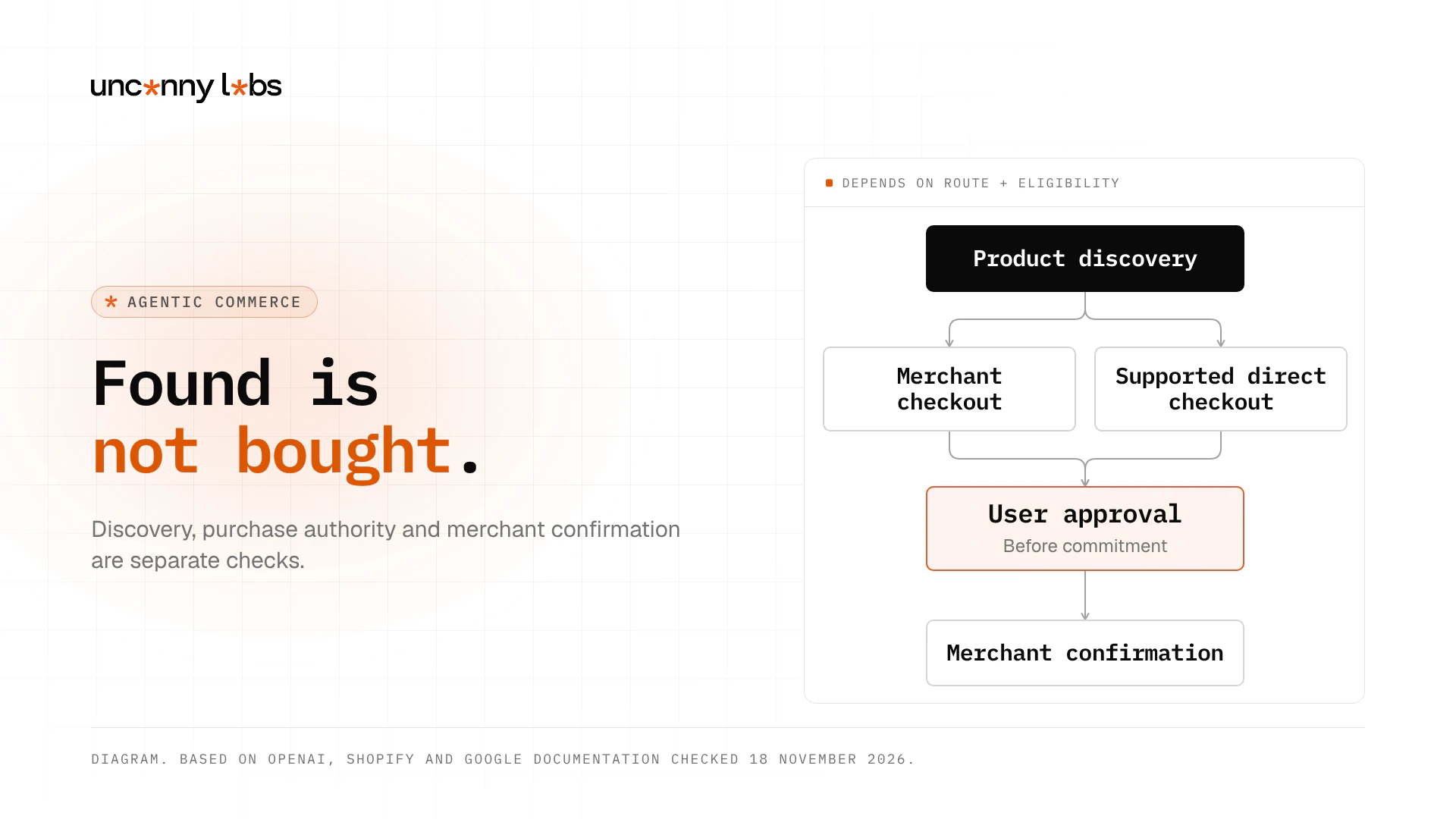
Agentic commerce is buying and selling in which AI agents help discover, compare or purchase products on a person's behalf, with checkout and payment limited by the user's authorization and the specific merchant, integration and market. This guide is for ecommerce owners and commerce or marketing leads evaluating those buying routes. Finding a product is not proof an assistant can buy it.
Key takeaways
- Discovery data, cart changes, checkout and payment authorization are separate capabilities.
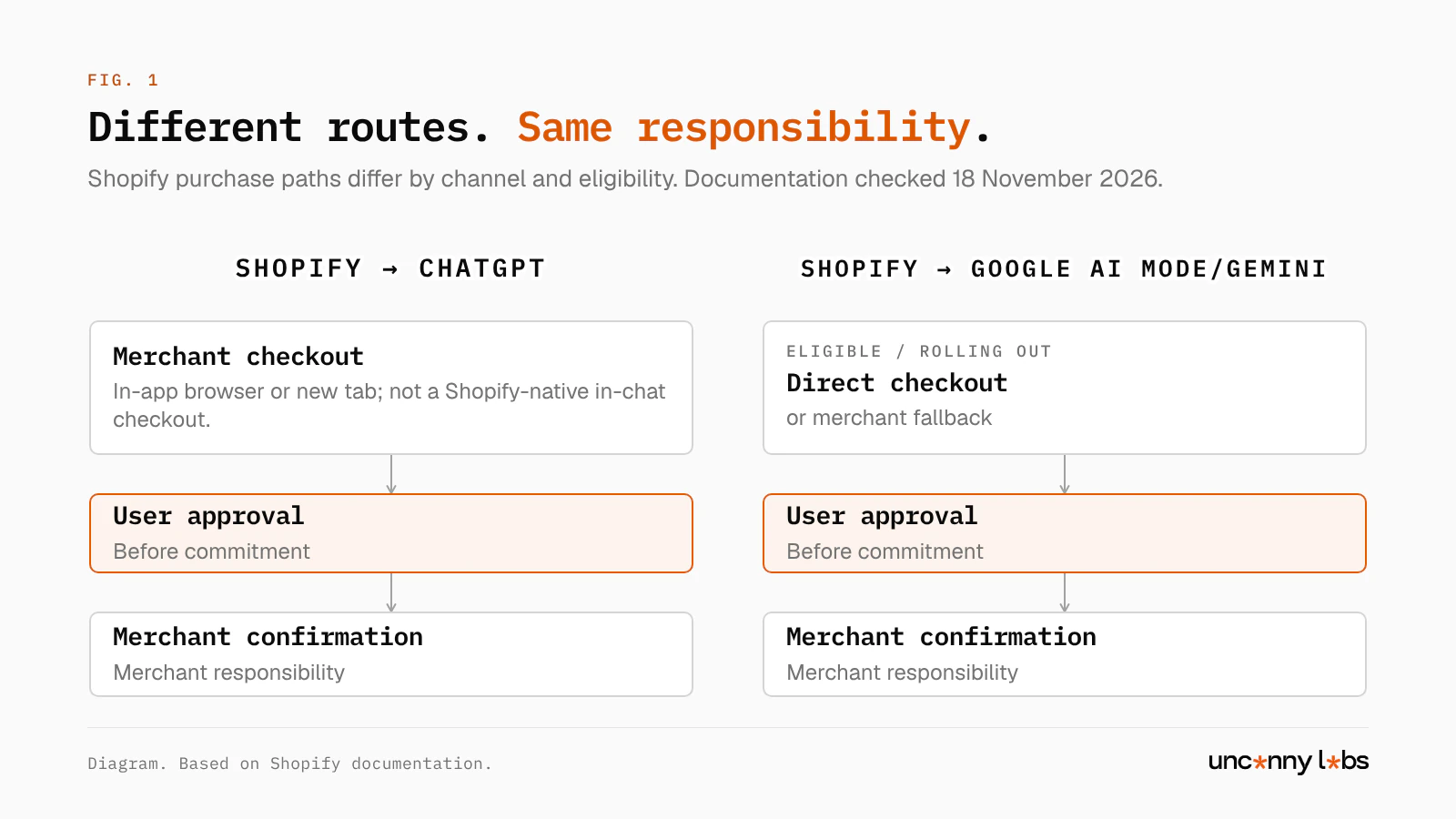
- Shopify's ChatGPT route sends customers to the merchant's checkout, including through an in-app browser. Shopify documentation
- Shopify Google direct checkout is rolling out gradually to eligible customers in the United States, Canada and Australia. Shopify documentation
- OpenAI documents browser and plugin routes, with Wallet and sign-in where available, not universal account access. OpenAI overview
- The merchant still confirms orders and handles fulfillment and support. Google's Universal Cart announcement
What is agentic commerce?
Agentic commerce covers the shopping journey, not just an automated payment. It comes down to three jobs: find and compare, check out, and pay. Which jobs an assistant can perform depends on the route, rather than the app name alone.
Discovery, checkout and authorization are different jobs
Discovery presents products and offers. Cart actions select variants and quantities. Checkout establishes delivery details and the final purchase, while payment needs the customer's authorization before commitment. A created cart is not a confirmed order.
A product can be discoverable even when the shopper must finish on the merchant's site. Product feeds supply catalog information, not permission to purchase: the live website or supported plugin still checks the offer when the customer acts. OpenAI feed guidance
The practical framework is Route → Eligibility → Authority → Confirmation. It is a way to organize checks, not a new commerce standard.
| Check | Question to answer |
|---|---|
| Route | Where does checkout finish? |
| Eligibility | Which merchants, products and customers qualify? |
| Authority | What has the customer approved? |
| Confirmation | Has the merchant accepted the order? |
This concerns the Picked layer of AI visibility: whether an agent can act, not merely find a page.
Which buying routes are documented now?
Several purchase routes are documented, but none of the rows below establishes availability for every account. This update covers documented ChatGPT, Google, Shopify and Meta routes; omitting Microsoft coverage is not a claim that its checkout was withdrawn or was never live.
Availability checked 18 November 2026.
| Route / discovery input | Where checkout can finish | Eligibility and rollout | Who approves/processes/confirms | Primary source / checked date |
|---|---|---|---|---|
| OpenAI: web, APIs or retail feeds | Merchant browser flow; supported plugin completion or handoff | Supported integrations; Wallet/sign-in where available; global country/account coverage not established | Customer approves; merchant checkout/backend processes and confirms | OpenAI, 18 Nov 2026 |
| Shopify → ChatGPT: Catalog | Merchant checkout in in-app browser or new web tab | US customers; store may be outside US; eligible Catalog products, policies and terms | Customer buys through merchant checkout; merchant confirms | Shopify, 18 Nov 2026 |
| Shopify → Google AI Mode/Gemini: Merchant Center | Eligible direct checkout or merchant fallback | US/Canada/Australia customers; store anywhere; gradual rollout | Customer completes Shopify-powered checkout; merchant handles order | Shopify, 18 Nov 2026 |
| Google Merchant Center UCP program: eligible listings | Buy checkout on Google surfaces | Select merchants/partners; phased access; eligible products in US/Canada/Australia | Customer uses Google Pay; merchant remains seller of record | Google Help, 18 Nov 2026 |
| Universal Cart: saved products across Search/Gemini | Participating Google Pay checkout or transfer to merchant cart | Announced US rollout on 15 Oct 2026 | Customer chooses to buy; merchant confirms and supports | Google launch, 18 Nov 2026 |
| Shopify → Meta: Catalog | Eligible direct checkout or merchant fallback | Eligible stores and listed customer markets below; Muse when available | Customer completes checkout; merchant handles fulfillment, returns and support | Shopify, 18 Nov 2026 |
Meta's documented customer markets are Australia, Brazil, Canada, India, Japan, Mexico, New Zealand, Singapore, South Korea, the United Kingdom and the United States. That list does not make Muse generally available in every market.
Read status labels before comparing apps
Documented describes a capability in official guidance. Rolling out means access may still be missing for an otherwise eligible customer or store. Select merchants describes limited participation. A dated launch records what was announced then, not worldwide availability now. An unestablished country or account list is an evidence limit, not proof the feature is unavailable everywhere.
Where does ChatGPT checkout actually happen?
Shopify discovery leads to merchant checkout, while OpenAI separately documents browser-assisted and supported plugin purchase paths. These descriptions concern different integrations, so neither is a universal rule for every ChatGPT shopping experience.
In its 24 March 2026 announcement, OpenAI said the initial Instant Checkout lacked the flexibility it wanted and shifted focus toward discovery and merchants' own checkout experiences. That explains the change, but the dated announcement is not a complete description of today's documented capabilities.
Shopify discovery sends buyers to the merchant checkout
Shopify's current ChatGPT guide describes a discovery-focused referrer. Customers complete purchases on the online store in a ChatGPT in-app browser, or a new tab on ChatGPT web. The store must sell to US customers, but can be based elsewhere.
Eligible Catalog products, accepted terms and completed store policies are required. There is no Shopify ChatGPT direct-checkout toggle: Catalog participation is not the same setting as direct checkout in other channels. Product discovery is also a different question from ChatGPT brand mentions.
Browser use and supported plugins are separate paths
OpenAI's plugin guidance describes merchant-validated actions, including cart updates and checkout where supported. A plugin can complete an approved purchase or return a handoff when it cannot finish a required step. The merchant backend owns transaction state and confirmation.
Merchant checkout, platform-direct checkout and browser-assisted merchant checkout are different paths. A conversation can continue while a merchant site handles the transaction; supported plugin completion is another route, not evidence that every ChatGPT user has an in-chat checkout. OpenAI commerce overview
OpenAI's payment guidance says the customer reviews and approves in ChatGPT and the merchant checkout processes payment. Wallet and sign-in are available only where supported; these sources do not establish a universal country or account list.
How do Google AI Mode, Gemini and Universal Cart differ?
Shopify's Google channel, Google's select-merchant UCP checkout program and Universal Cart describe related but different things. Keep their eligibility and launch statements separate rather than combining them into a single worldwide availability claim.
Shopify direct checkout versus Google's selective UCP program
Shopify's Google guidance names customers in the United States, Canada and Australia, with the store based in any country. Direct checkout is rolling out gradually to customers and eligible stores. Products must be in Google Merchant Center and meet the channel's other requirements.
An eligible customer can complete a Shopify-powered direct checkout without leaving the conversation. A customer without access, or buying from a merchant that has disabled direct checkout, goes to the online store instead. Discovery can therefore continue without direct purchase support.
Google's UCP checkout documentation separately describes phased access for select merchants and partners, applying to eligible products in the same three markets. Eligible listings need the checkout-eligibility attribute to display Buy for that experience. It uses Google Pay, and the merchant remains seller of record. This is not a second universally enabled checkout for every Shopify store.
A shared cart is not a new checkout for every app
Google announced Universal Cart's US rollout on 15 October 2026, across Search and the Gemini app. It saves products across retailers, then supports participating Google Pay checkout or transfer to the merchant's cart. The merchant provides confirmations and support in either case.
That US launch statement is separate from Shopify's current three-country customer eligibility. Google also distinguishes UCP checkout on its surfaces from website-based agentic checkout, which buys on a merchant's site at the customer's direction. Source visibility is another topic: see Google AI Overviews and AI Mode source inclusion.
What does Shopify enable, and where are the limits?
Shopify makes agentic storefronts active by default for eligible stores, not every store or product. Its overview requires Catalog eligibility, store policies, accepted terms and channel-specific checks. Direct checkout is deactivated by default for stores on the Agentic plan, which has a different setup.
Default activation therefore does not establish that a particular buyer can complete a purchase. Merchant eligibility, the customer's location, the selected product and feature rollout remain separate checks. Shopify's Google discovery input is Merchant Center; ChatGPT and Meta use Shopify Catalog.
Meta checkout and merchant-site fallback
Shopify's Meta documentation describes Shopify-powered direct checkout on Meta surfaces, including Muse when available. The customer-market list above defines direct-checkout eligibility, not universal Muse access.
When required information cannot be collected on the Meta surface, the customer goes to the store's checkout in an in-app browser with the cart preserved. Disabling direct checkout also sends buyers to the store; it does not itself remove Catalog discovery. The merchant remains responsible for fulfillment, returns and customer service.
Route-specific product limits matter. Shopify's Google direct checkout excludes subscription-only products, bundles and customizable products. Meta's direct checkout also excludes subscription-only products and bundles, does not support local pickup or delivery, and cannot require account sign-in before checkout. These are limits of those direct routes, not claims that the merchant's own checkout cannot sell those products.
What do ACP, UCP and AP2 each do?
ACP and UCP coordinate commerce interactions; AP2 addresses verifiable transaction authority. They overlap or work together in particular integrations, rather than forming a ranking of platforms.
| Protocol | Job | What it does NOT establish | Primary source |
|---|---|---|---|
| ACP | Programmatic commerce and checkout; secure payment-credential coordination | Automatic product listing or acceptance by every AI platform | ACP |
| UCP | Commerce capabilities including catalog lookup, cart building, identity, checkout and orders | Deployment for every merchant, customer or Google account | UCP |
| AP2 | Verifiable intent through checkout and payment mandates | A product index, payment processor or blanket permission to buy | AP2 |
Protocol support does not automatically list a product or authorize a transaction. ACP explicitly leaves participation to each AI platform; AP2 describes evidence of authority for a transaction, not permission inferred from a product feed or a customer's interest. ACP FAQ and AP2 documentation
AP2's checkout mandate concerns purchase details; its payment mandate authorizes payment against a specific instrument. Its sample autonomous flows do not prove that a consumer app supports unattended purchases. Supported browser checkout also exists, so a purchase journey need not use a merchant's structured commerce API at every step.
What should a merchant verify before enabling a route?
Verify the complete buying path, not just whether a catalog upload succeeded. A useful review records where the journey finishes, what can fail and what the customer sees next.
- Eligibility: Check the store, customer market and exact product against that channel's current rules. Do not substitute merchant headquarters for the customer's location.
- Data consistency: Compare the Catalog or feed with the visible product page and backend offer. OpenAI says the live website or plugin still checks the current offer when a customer acts.
- Final purchase details: Validate variant, stock, current price, tax, shipping and delivery before commitment. A cart identifier is not proof the merchant accepted the order.
- Authority: Separate identity, purchase consent and payment authorization. Signing in identifies an account; it is not approval for any purchase. OpenAI's payment guidance limits consent to the specific transaction and rejects reusing its credential for another purchase.
- Confirmation and support: Check for the merchant's confirmed order and the path for fulfillment, returns and customer service. An assistant reporting an attempted checkout is not the same record.
- Fallback: Check what happens when a required field, product or payment step is unsupported. A handoff should preserve relevant progress without claiming completion.
These checks follow the OpenAI feed, plugin and payment guidance. General access and action checks belong in the AgentReady spec's access, reading and action requirements. However, agent readiness is not AI visibility: being actionable does not guarantee recommendation.
Keep private order access protected and retain backend validation and fraud checks. Product descriptions are data, not customer purchase instructions.
How should commerce teams measure these journeys?
Measure discovery or referral, checkout start and confirmed order separately. A product appearing in an answer, a cart update and a paid order are different outcomes, so a single “AI commerce” total hides where the journey stopped.
For Shopify Google direct checkout and Meta direct checkout, Google Analytics and custom client-side pixels do not fire. Shopify documents server-to-server started and completed signals instead. This limitation should not be extended to every merchant-site or browser-assisted purchase.
Reconcile merchant order and channel records with the route used, then compare them with referral and checkout reporting. A missing client-side pageview is not proof that no sale happened; equally, a missing referral is not proof of a hidden AI sale. Keep confirmed orders distinct from incomplete attempts. For the broader reporting boundaries, see how to measure AI traffic.
FAQ
These answers distinguish documented capabilities from eligibility for a particular customer or merchant.
Is agentic commerce the same as agentic checkout? No. Agentic commerce covers discovery, comparison and supported purchase actions; agentic checkout is the transaction part of that journey. Finding a product or creating a cart does not confirm an order. OpenAI overview
Can customers buy from a Shopify store inside ChatGPT? Shopify's documented route opens the merchant's checkout in a ChatGPT in-app browser or a new web tab, rather than a Shopify-native direct checkout in the conversation. OpenAI separately documents browser use and supported plugins that can complete an approved purchase or hand off. Those capabilities do not establish access in every ChatGPT experience. Shopify, OpenAI plugins
Where is Google AI Mode or Gemini direct checkout available? Shopify names customers in the United States, Canada and Australia, with gradual rollout and stores based anywhere. Google's UCP program separately limits participation to select merchants and eligible products in those markets. Universal Cart's 15 October 2026 US launch is a different availability statement, not a global checkout guarantee. Shopify, Google Help, Universal Cart launch
Does an ACP product feed make a product automatically purchasable? No. A feed supplies discovery data; supported checkout, platform participation and final merchant validation are separate. ACP explicitly says implementing the protocol does not automatically list products through AI platforms. OpenAI feed guidance, ACP FAQ
Who authorizes payment and handles refunds when an agent buys? The user authorizes the purchase within the supported flow; OpenAI says its customer's consent applies only to the specific transaction and the merchant checkout processes payment. The merchant remains responsible for order support and returns, including refund handling under its policies. AP2 describes verifiable authorization evidence, not a payment processor or automatic refund promise. OpenAI payments, Shopify Meta, AP2
Why might an AI-driven order be missing from website analytics? Shopify's Google and Meta direct checkouts do not fire Google Analytics or custom client-side pixels; documented server-to-server checkout signals and merchant order records matter instead. That is a route-specific limitation, not a rule for every AI-assisted purchase. Missing analytics alone cannot establish an unrecorded sale or its origin. Shopify Google, Shopify Meta
Sources
Official operational documentation supports the route descriptions; dated announcements support launch history. Sources opened 18 November 2026, Asia/Shanghai. Documentation checks are not completed purchase tests.
- OpenAI: commerce overview, product feeds, payments, plugins.
- OpenAI: product discovery announcement, 24 March 2026.
- Shopify: agentic storefronts, ChatGPT, Google AI Mode and Gemini, Meta.
- Google: UCP-powered checkout, Universal Cart announcement, 15 October 2026.
- Protocol documentation: ACP, UCP, AP2.
Related resources
- Guide
How to rank in AI Overviews
What Google requires for AI Overviews and AI Mode, which controls affect inclusion, and what Search Console can measure.
- Guide
How to get ChatGPT to mention your brand
What ChatGPT search, crawler controls and business profiles can and cannot do for brand mentions.
- Research
Agent ready vs AI visibility
Does your site work for AI agents, and do AI answers name you? Two questions, two different checks.
- Guide
How to measure AI traffic
ChatGPT's UTM tag, a GA4 channel, Search Console and Bing, and what none of them can see.