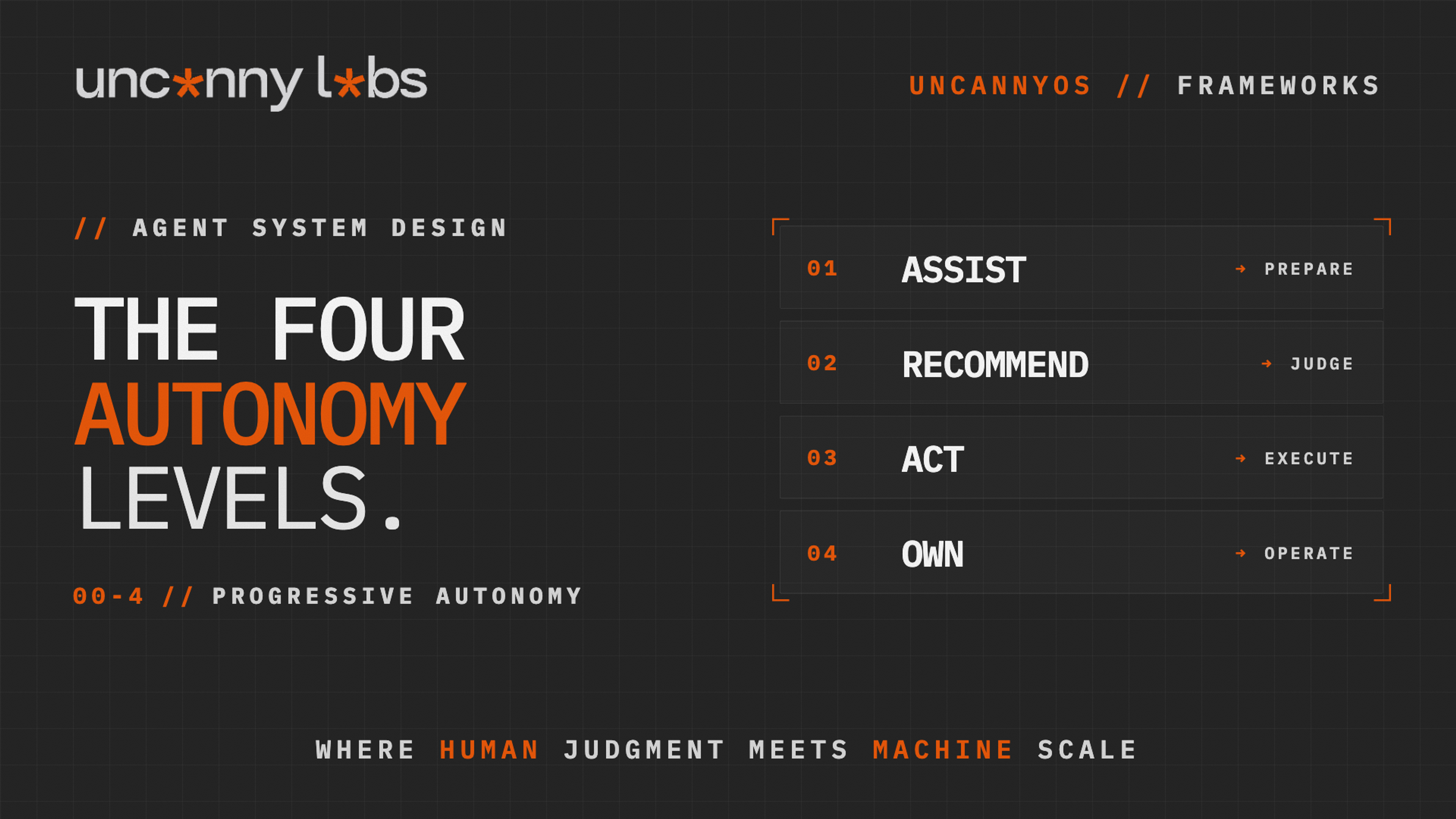
Agents climb the autonomy ladder one rung at a time, moving up only as they earn trust.
Agents don't have a fixed level of autonomy that the team decides at design time and forgets. Every agent in a production system sits on one of four rungs. Each rung has exit criteria that determine whether the agent is ready for the next one. The agent earns each rung through evidence produced inside the system, and the system only promotes the agent when the evidence clears the bar. Agents that haven't earned the next rung stay where they are. Agents that can't earn any rung get removed.
This is what most agent deployments get wrong. They treat autonomy as a deployment setting. Ship the agent in "supervised" mode on day one. After three months, flip the setting to "autonomous" because the timeline said so. Time doesn't measure readiness. Some agents hit their criteria in six weeks while others are still missing them at nine months. A calendar can't tell the difference.
The first post of this series defined the five agent types and the boundary rules that keep each type honest. The second went inside each agent and covered the four components every one is built from: Brain, Memory, Tools, Governance. The third defined the five workflow archetypes and how agents compose. This post is the fourth dimension of the design stack, covering how each agent inside any of those archetypes moves from Assist to Own, one rung at a time, on evidence rather than timeline. The fifth and final post is the capstone walkthrough: a full Uncanny Works production system where every primitive above shows up inside one running deployment.
---
The Four Rungs
There are four autonomy levels. Each one is a different contract between the agent and the human overseeing it. Progressing up the ladder changes what the agent does, who reviews what, and where the accountability sits.
Assist. The agent produces while the human reviews and executes. Every output touches human hands before it moves the system. The agent is helpful, the human is authoritative. This is the entry level for almost every agent in a production workflow. It is also the level where shadow-mode deployments live. The agent's output is visible, logged, compared to human performance, and never actually used until it has earned a better rung.
Recommend. The agent produces a judgment which might be a recommendation, a classification, a score, or a plan. The human still decides whether to act on it. The difference from Assist is that the agent's output now carries interpretation, not just preparation. An Assist-level agent hands the human material to read. A Recommend-level agent hands the human a conclusion to agree with, disagree with, or override.
Act. The agent executes within bounded authority. The human designed the bounds ahead of time (the action space, the guardrails, the escalation triggers, the rollback mechanism) and the agent operates inside them without touching the human for routine decisions. The human reviews exceptions, monitors drift, and holds the escalation path open. Most real production agent work happens at this rung.
Own. The agent operates end-to-end without routine human touch. The human monitors dashboards, handles rare escalations, and audits the system's behavior on a sampling basis. Own is not "no oversight." The oversight is just different. It is statistical rather than transactional. The agent owns the task and the human owns the system.
The ladder runs in that order and agents climb one rung at a time. Most of the high-profile agent failures trace back to a skipped rung. A system that moves from Assist directly to Own has bypassed the two rungs where the evidence for trust gets produced.
---
Before the Ladder: Where Is Full Autonomy Ever Permissible?
The ladder is operational. Before an agent climbs any of it, there is a strategic question that sits above it. For this workflow, in this organization, at this point in time, is full autonomy ever permissible at all?
The strategic assessment works in three steps. First, assess the context: the industry, the regulations, the organizational values. Second, map the workflow against a two-axis grid of what you are optimizing for and what is at stake if something goes wrong. Third, set the guardrails at one of four strategic levels: Active Control (human authority at all times), Human Augmentation (AI assists, human decides), Guided Automation (AI acts, human oversees), and AI Autonomy (minimal human intervention). The assessment produces a ceiling for the workflow and not every workflow is eligible for every rung of the ladder, regardless of how well the agent inside it performs.
This reframes one of the most common mistakes in agent deployment. Teams operate as if the ladder is the whole game: earn the evidence, promote the rung. That works only inside workflows the organization has already decided can support the rung. A risk-assessment Analyst in a regulated banking workflow may become operationally eligible for Act based on its edit-rate evidence and still not be allowed to graduate there, because the strategic assessment says this workflow stops at Recommend. The agent hasn't failed; the ceiling was set upstream of the ladder, and the ladder is operating correctly when it doesn't override it.
In practice, do the strategic assessment before the deployment, not after. Write the ceiling into the design and treat the ladder as the within-ceiling governance layer. Agents that become eligible to graduate past their workflow's ceiling should not graduate; they should either stay at the ceiling or route back through the strategic layer for re-evaluation when the context changes.
---
How Each Agent Type Climbs the Ladder
Not every agent type can reach every rung. The type's boundary rule determines its ceiling. A Tasker can reach Own for a bounded, reversible operation. An Assistant cannot, because by definition an Assistant that executes is no longer an Assistant. The ladder is shared but the ceilings per type are not.
The Assistant starts at Assist and typically stays there. Its whole job is to prepare material for another agent or a human to use. Graduating past Assist would violate the type's boundary rule, since an Assistant that decides is an uncontrolled Analyst. In practice, the evolution an Assistant undergoes is not movement up the ladder but refinement inside Assist. It gets better at what it prepares, faster at preparing it, and cheaper per preparation. If you find yourself wanting to give an Assistant autonomy past Recommend, what you actually need is a different type in its place.
The Analyst starts at Assist in shadow mode and graduates to Recommend once its interpretations match or beat human judgment at the same task. Recommend is the Analyst's home. It can occasionally graduate to Act in highly bounded scenarios where the recommendation and the action are essentially identical, such as a risk score that auto-enrolls leads into a tiered sequence, or a sentiment classification that auto-routes tickets. Even those bounded cases require a Guardian auditing the Analyst's output against threshold drift. The boundary rule for Analysts says they never pull the trigger; what the ladder allows is for the Analyst's recommendation to be wired to a deterministic Tasker that does, with the governance split clean across two agents.
The Tasker climbs the highest on the ladder. It starts at Assist with its would-be actions shown to a human for approval. It graduates to Recommend as drafts it produces get shipped with light human edits. It graduates to Act once its edit rate drops below a defined threshold and its rollback rate stays inside a tight band. And for sufficiently bounded, reversible, low-risk tasks (routine notifications, CRM updates against a well-defined schema, scheduled publication of pre-approved content), a Tasker can reach Own. The blast radius of a Tasker at Own is small by design. Its action space was enumerated before the Tasker ever touched the rung below.
The Orchestrator has a natural ceiling around Act. It can climb from Assist (plans shown, humans execute) to Recommend (plans presented for approval before dispatch) to Act (dispatches within pre-approved bounds, escalates edge cases). Reaching Own is rare and, in most organizations, not desirable. The Orchestrator's blast radius is large, because it touches multiple downstream agents and, through them, multiple external systems. An Orchestrator at Own is a single point where a planning error can propagate across the entire pipeline. Most Orchestrators in production live at Act permanently. The human accepts that they'll review the escalation queue. The benefit of the archetype still holds.
The Guardian is the inverse case. It starts at Assist (surfacing issues for human review), graduates to Recommend (blocking by default with human override available), and in most cases stops there. Graduating a Guardian to Act means giving the Guardian real-time blocking authority, where the system will refuse to ship something the Guardian rejects. That's appropriate in domains where the compliance cost of missing a violation is catastrophic (regulated finance, healthcare, child safety). For most workflows, a Guardian at Recommend with a clean escalation path is the right permanent home. Graduating a Guardian to Own would mean no human in the compliance loop at all, which is how Guardians get optimized for completion. That's the exact anti-pattern that collapses their function.
---
Exit Criteria: How You Earn Each Rung
Evidence, not timeline. Every rung has exit criteria written before the deployment starts. The agent graduates when the criteria are met. The agent does not graduate when the calendar says so.
Assist → Recommend. The exit criterion is quality parity. Run the agent in shadow mode alongside the human doing the same task. Log the agent's output. Compare it to the human output on the same inputs. The graduation condition is two to four weeks of matching or beating the human baseline. The specific bar depends on the task, but the pattern holds. The agent has to produce work that a reviewer can't distinguish from the human's, at the same or better quality. If the agent's output is materially worse than the human's, it stays at Assist. If the tasks are too different to compare, the shadow-mode data is incomplete and the agent isn't ready.
Recommend → Act. The exit criterion is edit rate. Run the agent in a supervised mode where it produces work that humans edit before it ships. Track the average edit rate per output. When the edit rate drops below five percent and stays there for two to four weeks of real workflow (not a cherry-picked window), the agent graduates to Act. Five percent is a typical target; the number is set per workflow based on what "materially edited" means in that context. The principle is that when humans are reviewing the agent's work and only touching five percent or less of it, the human review is producing diminishing returns and the agent is ready to act within bounds.
Act → Own. The exit criterion is rollback rate. Once the agent is acting, track how often a human has to reach in and undo something the agent did, whether that's an action rolled back, a customer touched who shouldn't have been, or an output pulled before it went live. When the rollback rate drops below one percent over a multi-week window, the agent has demonstrated that its action space is tight enough and its judgment steady enough for unattended operation. At this point the human transitions from reviewing exceptions to monitoring dashboards and auditing samples.
The three exit criteria above measure the agent's performance. They don't measure the human side of the relationship. There's a further dimension worth naming: the gap between what the agent is technically capable of, what the organization is actually ready to absorb, and what has been realized in production. Technical capability produces potential impact. Organizational ability produces realizable impact. State of implementation produces realized impact. The gaps between these three curves are where rungs get earned on paper and fail in practice.
What this means operationally is that each rung transition is governed by two axes, not one. The quantitative axis is the exit criterion: quality parity, edit rate, rollback rate. The qualitative axis is whether the oversight team has actually internalized the rung. An agent whose edit rate has dropped below five percent but whose human operators still instinctively reach for the review queue has not closed the trust gap. Closing it is part of earning the rung.
Adoption is the third rung-gate metric alongside Accuracy and the quantitative thresholds. Adoption measures human-and-system integration rate: how much of the agent's capability is actually being used, how cleanly the humans around the agent work with it, how many cases route through the agent's lane without someone rerouting them out. An agent with high accuracy but low adoption is producing work the organization isn't consuming. That is not a ready-to-graduate agent. It is an isolated capability. The exit criterion set should include an adoption check alongside the quantitative metric. Has the oversight team stopped second-guessing the agent's output at the current rung? If the answer is no, the adoption gate isn't cleared, regardless of the numbers.
A final qualitative signal worth naming is behavioral. After an agent has been running at its earned rung cleanly for a while, the human operator around it tends to shift posture. They move from reactive to active. Before, the operator handled situations as they arose and corrected the system when it erred. After, the operator stops correcting and starts leveraging: anticipating situations, leading differently, using the agent's capability as a forward lever rather than a backstop. That behavioral shift is a signal that the rung was truly earned. When the humans around an agent stop being reactive and start being active, the system has crossed into functioning partnership. Until that shift, the numbers may have met the threshold but the adoption layer hasn't cleared.
Each of these exit criteria is measurable and each one is set before the agent deploys. Each one has a tight enough bar that graduation is an event, not a drift. Most agents in production workflows stabilize at Act permanently, and that is a correctly-functioning system. Not every agent needs to reach Own. Most don't need to, and the organizations that push every agent to Own without the evidence are the ones producing the high-profile failures.
---
The Guardian at Every Rung
The Guardian shows up at every rung, with a different role at each one.
At Assist, the Guardian is watching everything. The agent produces, the human reviews, and the Guardian flags anomalies in the agent's output for the human's attention. It is the safety layer during the evidence-gathering phase.
At Recommend, the Guardian reviews the agent's recommendations before the human decides. It is a second-order check, not blocking the agent but surfacing cases where the recommendation looks structurally suspect with threshold drift, unusual confidence levels, distribution shifts from prior outputs.
At Act, the Guardian checks the agent's outputs at runtime. This is the rung where the Guardian's blocking power matters most. The agent is executing without routine human review, and the Guardian is the layer that can stop an action before it ships when the action would violate policy. Real-time gates, policy checks, and compliance validations are all Guardian work at this rung.
At Own, the Guardian operates on audit and sampling. The agent is running end-to-end, and the Guardian is the mechanism that catches drift before it becomes incident. Sample a random subset of outputs. Measure against policy. Compare to baselines. Flag deviations. The human that would have been reviewing every action at Act is now reviewing the Guardian's reports at Own.
The Guardian is the agent that makes Own possible. Without a functioning Guardian, no agent should reach Own regardless of its performance on edit rate and rollback rate. Those metrics show the agent is producing acceptable work. They do not show the agent will keep producing acceptable work when the input distribution shifts, when an adversarial case arrives, when the underlying model is silently updated. The Guardian is the layer that notices.
---
Anti-Patterns
Five failure modes show up repeatedly when teams deploy the ladder.
Timeline-based graduation. The deployment plan says the agent moves from supervised to autonomous after ninety days. Ninety days pass and the agent gets promoted. Nobody checked the edit rate. The agent was not ready, but the calendar was, and the system pushed the wrong rung. The fix is straightforward. Every graduation is gated by a measurable exit criterion, not a date.
Skipping rungs. The team deploys an agent directly at Act or Own because "we've seen this pattern work at other companies." Other companies are not evidence about your workflow. The rungs exist because the evidence each rung produces is different. Shadow mode shows quality parity, supervised mode shows edit-rate behavior, and Act shows rollback behavior. Skipping a rung skips the evidence that rung produces, and when something fails at the rung above, the post-mortem has no data to reconstruct what went wrong.
No Guardian at upper rungs. The agent graduates to Act or Own, but no independent Guardian was deployed alongside it. The system now has no check beyond the agent's own performance. At scale, every agent drifts, and there is nothing watching for the drift. The first indication of trouble is an incident, and the incident is also the first time anyone audited the agent in production.
Graduating the wrong type. An Assistant gets promoted to Act because "it's been doing a great job." An Assistant that acts is, by the type's boundary rule, no longer an Assistant. It becomes an uncontrolled Analyst or an unbounded Tasker. The fix is not to promote the type past its ceiling. The fix is to split the agent into two: one Assistant that prepares, and one new Analyst or Tasker that takes the prepared material and does the downstream work, each at the right rung of the ladder.
Permanent shadow mode. The inverse problem is that the agent has demonstrably matched the human baseline for eight weeks, but the team never promotes it. Shadow mode becomes a forever-state. The cost of running the agent in parallel with the human never amortizes. The organization gets no production value from a system that has already proven itself. If the exit criteria are met, the agent graduates. Extending shadow mode past its evidence threshold is its own anti-pattern.
---
FAQ
What is Progressive Autonomy?
A four-rung ladder (Assist, Recommend, Act, Own) that describes the level of autonomy an agent has inside a workflow. Progressive Autonomy is the design pattern where agents start at Assist, climb one rung at a time, and earn each promotion through measurable evidence rather than calendar milestones.
Why not deploy agents at full autonomy immediately?
Because there is no evidence at day one that the agent will perform at full autonomy. The rungs produce different kinds of evidence. Shadow mode produces quality-parity evidence. Supervised execution produces edit-rate evidence. Bounded action produces rollback-rate evidence. Skipping rungs means graduating without the data that rung would have produced, which is how agents reach Own without anyone being able to prove they deserved to.
What are the typical exit criteria between rungs?
For Assist to Recommend, two to four weeks of agent output matching or beating the human baseline in shadow mode. For Recommend to Act, edit rate below five percent on real workflow output over two to four weeks. For Act to Own, rollback rate below one percent over a multi-week production window. The specific numbers are set per workflow based on what each metric means in context. The principle is that each criterion is measurable and set before deployment.
Does every agent need to reach Own?
No, and trying to push every agent to Own is an anti-pattern. Most agents in production workflows stabilize at Act and stay there. Some agents (Guardians, Orchestrators with large blast radius) have natural ceilings below Own. The goal is the right rung per agent, not the highest rung per agent.
What happens if an agent stops meeting its exit criteria after graduation?
The agent demotes. A Tasker at Act whose rollback rate climbs above the threshold moves back to Recommend until it proves itself again. An Analyst at Recommend whose edit rate on its recommendations starts rising gets returned to Assist for a fresh shadow-mode window. The ladder works in both directions. The organizations that treat promotion as permanent are the ones that get surprised when a previously-reliable agent silently degrades.
Does the ladder replace the need for Guardian agents?
No. The Guardian is the mechanism that makes the ladder safe at its upper rungs. The ladder produces the evidence that an agent can operate at a given level. The Guardian produces the ongoing monitoring that catches drift after the agent has graduated. They solve different problems. Agents climb the ladder on their performance. Guardians make sure the climb stays honest.
---
Autonomy is earned, not assigned. Four rungs. Measurable exit criteria. A strategic ceiling set upstream. A trust gap closed through adoption. A Guardian at every rung. This is the dynamics layer of the Agent System Design. Once the types are defined, the components are built, and the archetypes are composed, the ladder is what governs how each agent inside the system earns its way to unattended operation.
If you're designing an agent system and haven't read the earlier parts, the Five Agent Types is the first primitive. The Four Components of an AI Agent goes inside each type and covers what every agent is built from. The Five Workflow Archetypes covers how agents compose. The Agent × Archetype Matrix is the capstone, a full walkthrough of Uncanny Works where types, components, archetypes, and autonomy all show up inside one running production system.
— Arthur Simonian Founder, Uncanny Labs · AI Workforce Agency