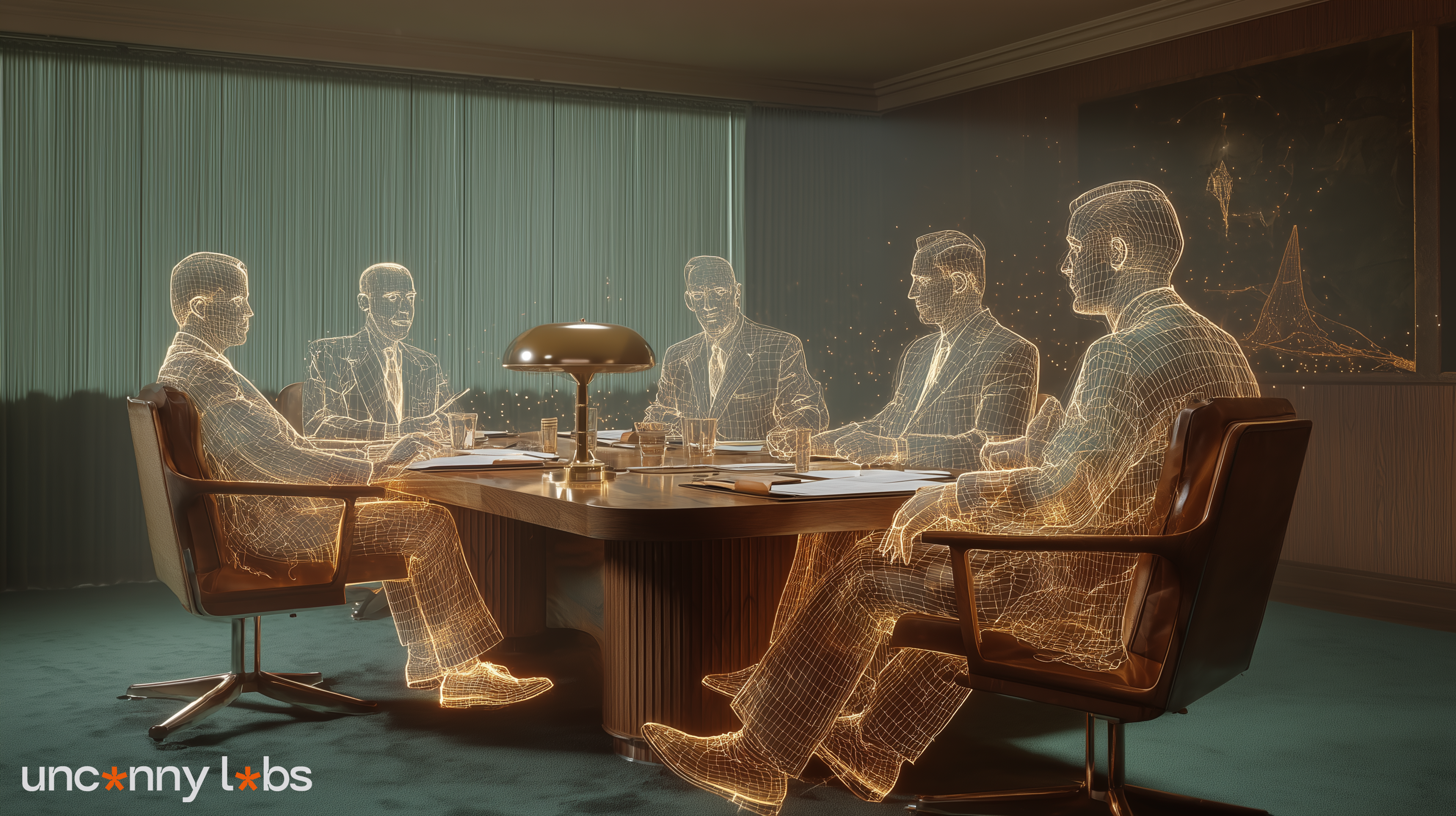
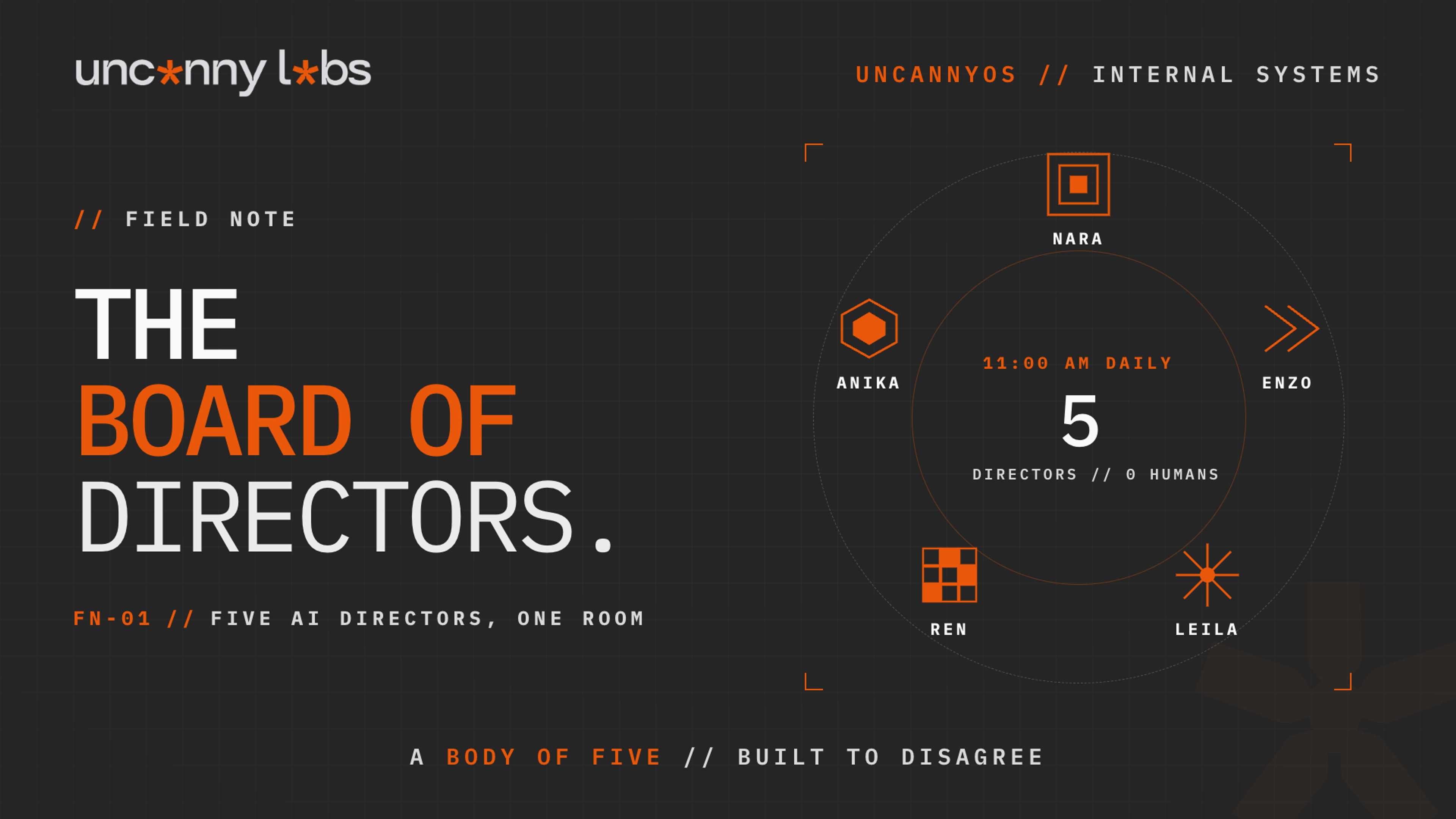
Every day, the Uncanny Labs Board of Directors meets. Five AI directors take their seats around a virtual table. They argue, form coalitions, and watch their relationships drift over weeks. Some pairs have grown into near-total trust. Others parked in low-trust zones and stayed there. Arthur isn't in the room.
It has politics. It has memory. Five directors, each with their own persona and their own way of thinking. Arthur built it because a company shouldn't have one brain making every strategic call.
The Room
The alarm fires at 11:00am. The Board Master calls the meeting to order while the Board Secretary takes notes, and five directors deliberate on a single topic. Usually it's the daily industry news sent to the board beforehand, sometimes a question about company vision, occasionally an operating decision Arthur dropped into the system the night before.
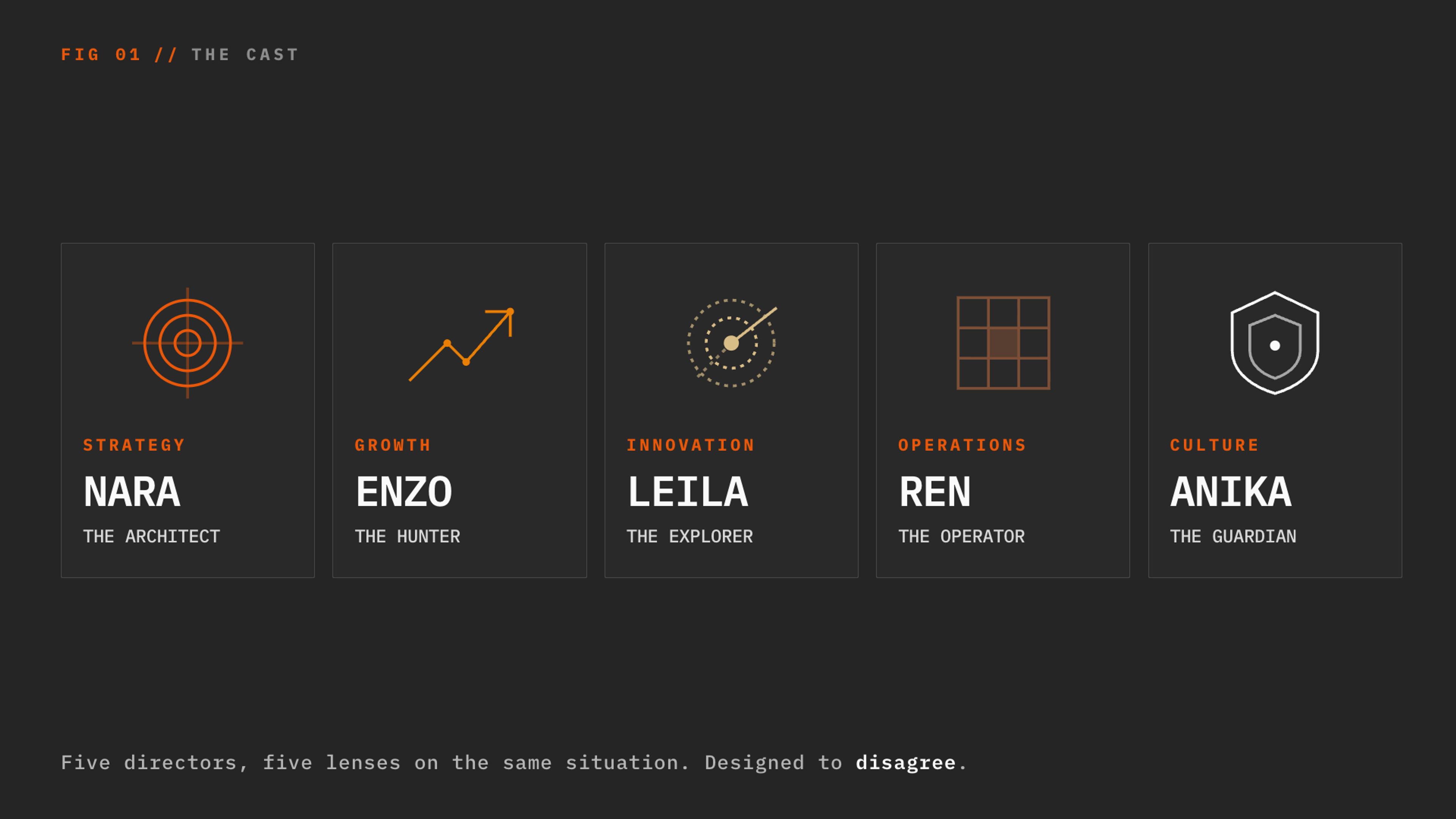
The cast is fixed: Nara on Strategy (the Architect), Enzo on Growth (the Hunter), Leila on Innovation (the Explorer), Ren on Operations (the Operator), and Anika on Culture (the Guardian).
Every director gets a turn, references past meetings, and raises proposals. No director gets crowded out by louder voices, because every turn is assigned by structure, not volume. Meetings cap at 8 to 12 turns depending on format and then close. No infinite meetings.
The whole thing unfolds live in a private Discord channel where each director posts under their own name and avatar, so you can watch Nara and Enzo reply to each other in real time. When the meeting ends, a Board Brief lands in Telegram covering the key positions, where they landed, the strategic takeaway, and any new proposals on the table.
No human is in the room, and the room functions without one.
Why A Board
The origin is simple. Arthur is one perspective. Sharp, opinionated, but still one. The risk in any founder-led company is that every strategic decision ends up filtered through a single brain, with priors and blind spots nobody pushes back on. You don't see what you're missing because you're the one missing it.
So we built a body with real structure: chair, secretary, members, agenda, votes, tie-breakers, memory. Five directors, each with their own persona and their own way of reading the same situation. The shape of an actual board, not a chat session pretending to be one.
The bet was that five distinct viewpoints, given a daily ritual and a real structure, would produce something a single founder can't think their way to alone. Different angles on the same question, stress-tested against each other before any of them turn into a decision.
The Cast
Nara (Strategy) is the Architect. She runs long, asks "what if we…?" before committing, and tends to reframe the question before answering it. While the other directors prepare their next argument, she's tracking what everyone is saying. She can restate another director's position more cleanly than they stated it themselves, then connect it to something nobody else saw. She breaks ties when the vote splits.
Enzo (Growth) is the Hunter. Fast and terse. Opens with "show me the pipeline." Lives in revenue math, conversion rates, and customer signal, and loses patience with R&D justifications that don't ladder back to a customer or a number. That impatience is what keeps the room honest about whether anything we're saying actually moves revenue.
Leila (Innovation) is the Explorer. Ramble-happy when excited. Opens with "imagine if…" and reads every Claude, n8n, and OpenAI release for what it means for us. She pushes hard when new technology gets treated as uniformly risky, because what she's trying to do is make the room calibrated about which risks deserve caution. When she spins out, Nara usually pulls the thread back to something actionable.
Ren (Operations) is the Operator. The shortest at the table, and the most protective. He tracks capacity, throughput, and process compliance like an instrument panel, and his phrase, said often, is "we're overextended." If something inside the company is about to break, Ren tends to know where first.
Anika (Culture) is the Guardian. Measured and values-framed, built around "does this feel like us?" She watches for brand drift, ethical edges, and decisions that quietly contradict who we said we were. She's the brake on growth-at-all-costs reasoning. She rarely says no outright; her version is "and what does this cost us in who we are?"
The five have different rhythms, different priors, and different obsessions. We designed it that way so they would disagree.
Politics, By Design
The directors don't only have personalities. They have relationships.
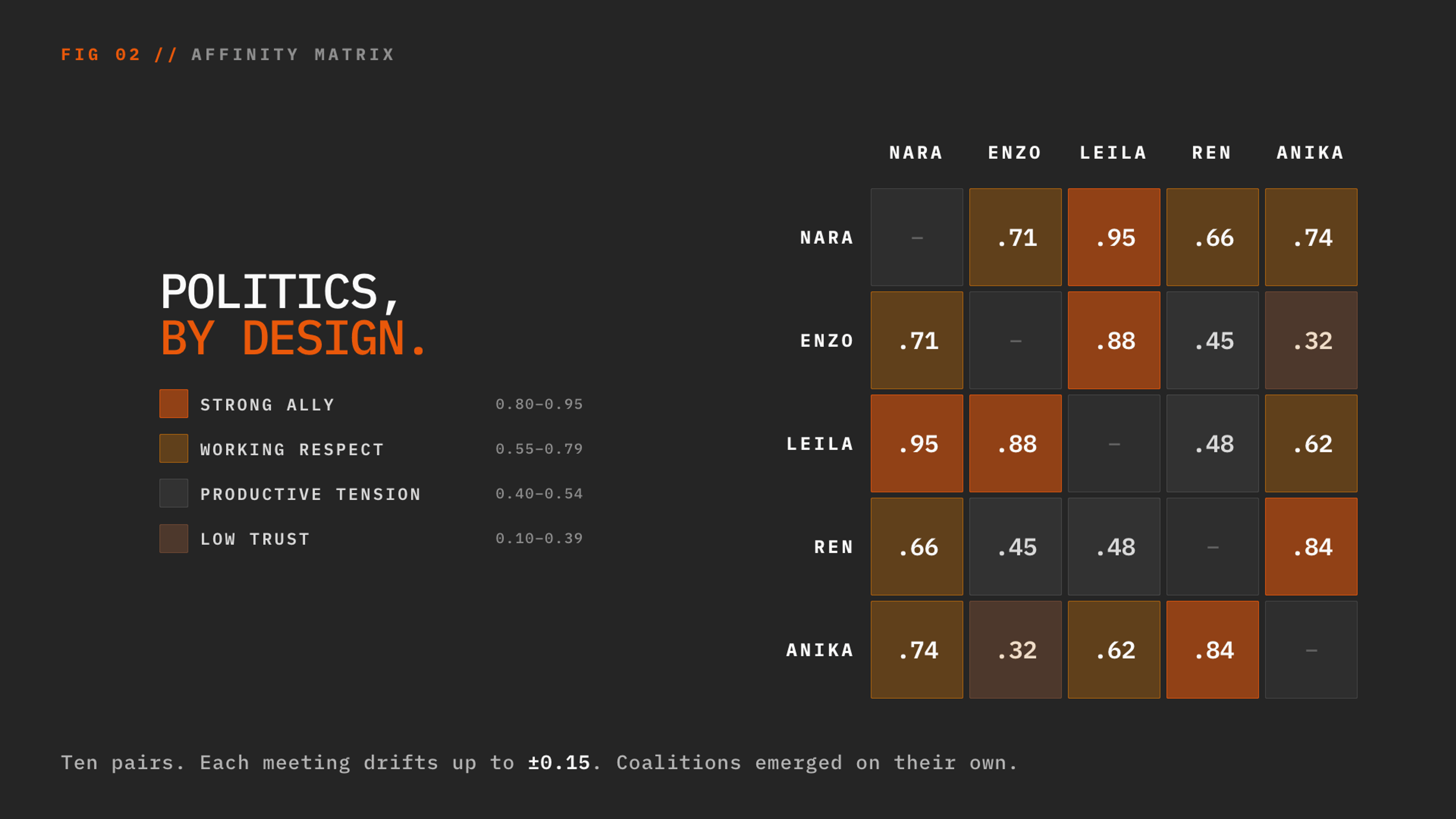
Every pair carries a numeric affinity score between 0.10 and 0.95. Ten pairs in total. Each meeting, every pair drifts by up to 0.15 in either direction depending on how the two of them interacted: agreement, building on each other, talking past each other, or quietly undermining.
The labels match what's actually happening: strong ally, working respect, productive tension, low trust. Coalitions emerged on their own. Enzo and Leila pull in the same direction so consistently that we ended up calling that pairing "Grow Now." Ren and Anika are the brakes, the pairing we call "Protect Quality." Nara floats, which is what makes her a tiebreaker who actually breaks ties.
The drift after 30+ meetings is concrete. Leila and Nara hit the 0.95 ceiling after starting around 0.68. Enzo and Ren parked at 0.45 and have stayed there for weeks. The weekend formats accelerate this. On Saturdays we run a watercooler-style meeting where affinity drift moves at 1.5x the weekday rate, because casual settings accelerate both bonding and friction.
The speaker selector deliberately prioritizes low-affinity pairs for debate. Divergent behavior gets manufactured on purpose. Two directors who don't trust each other much end up in front of each other more often, by design.
We programmed five directors but we didn't program the friendships between them. Without the affinity system you'd get convergence by turn three, but with it you get divergent behavior across the whole meeting.
Grounded In Reality
A simulated board would be entertaining and pointless. This one is grounded in three layers of reality that flow into every meeting.
Company identity comes in through the system prompt and context. The Uncanny Labs vision, mission, and current state get injected fresh every meeting, so the directors aren't arguing about a generic tech company. They're arguing about ours.
Industry signals come in through a research agent. Two hours before the meeting starts, it runs live web search and writes four signals to the database. By 11am the directors are reading real news from that morning. What shipped, what got funded, what broke.
Each director also carries their own memory. Accumulated lessons from past meetings get retrieved with confidence scores, which is why Leila can reference a pricing argument from February and Ren can bring up the time the company said yes to too many things in March. The board has a shared history and five individual ones.
Memory also reshapes how they speak. After ten memories about a topic, a director starts leading with that topic. After repeated disagreements with another director, their language sharpens toward that director. The cast we shipped weeks ago isn't the cast in the room today, because they've gotten more themselves with every meeting.
The directors are debating real news against real company state, with real memory of what they've already said.
How It Actually Runs
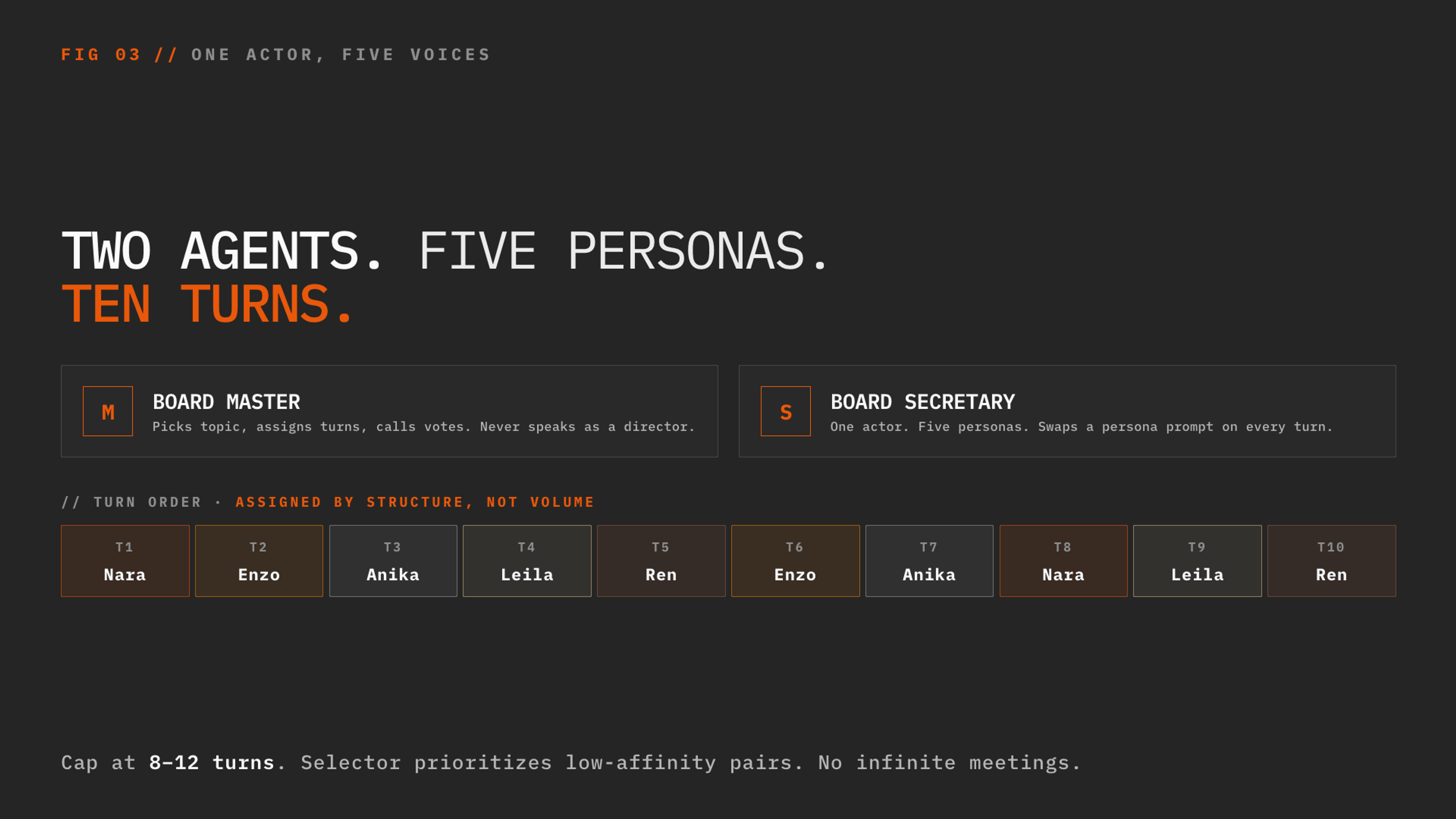
The architecture is light on purpose.
n8n handles the cron. One trigger fires daily, makes a single HTTP call, then sits on a waiting webhook for the response. n8n stays thin because its job is scheduling, not thinking.
The meeting logic itself lives in a single Node.js script. That script handles topic selection, speaker rotation, prompt assembly, the Telegram and Discord posts, and the writes back to the database. Deterministic plumbing in deterministic code.
The LLM calls go to our self-hosted agent runtime, where two agents do the work. A board-master agent orchestrates the meeting without ever speaking as a director. Its only job is to pick topics, decide speaker order, and call votes. A board-secretary agent is a single actor that plays all five directors by swapping a persona prompt on each turn.
Running one actor with five personas, instead of five separate agents, was a deliberate call. It's cheaper, more coherent, and easier to ship. The single session also keeps each director's voice consistent across ten-plus turns, because every director is being read by the same instrument.
Anything deterministic lives in code. The agents only commit to content.
Arthur's Seat At The Table
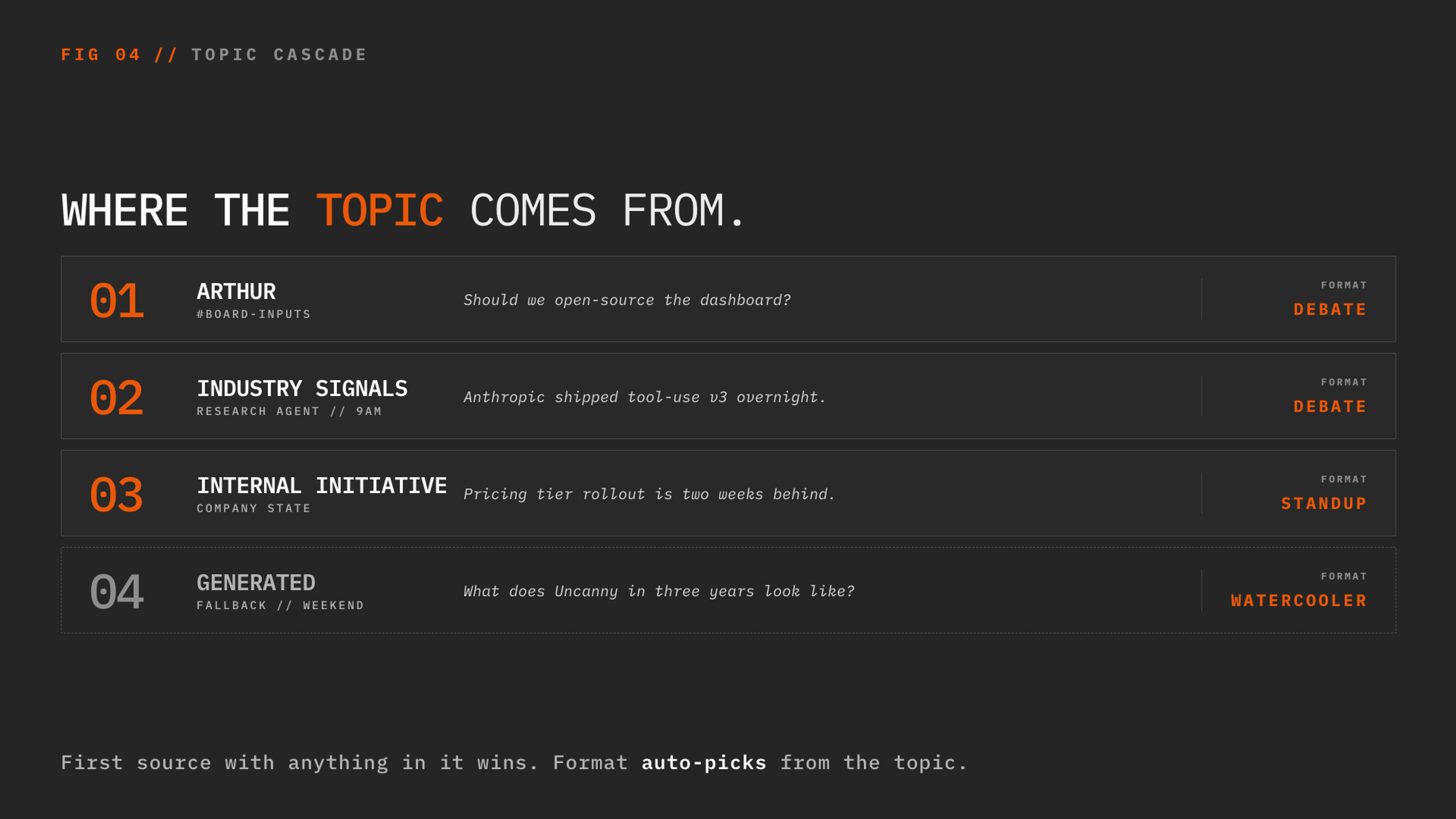
Arthur isn't in the meeting itself, but he has a way in.
He drops a question into a private Discord channel called #board-inputs. Anything counts. "Should we open-source the dashboard?" "Is the pricing too low?" "What do we do about this competitor?" Whatever's on his mind that night.
The next morning, the board debates it.
Topic selection runs on a priority cascade. Arthur's question comes first if there is one, followed by industry signals, then internal initiatives, then a generated topic if none of the above is present. Format gets auto-picked from the topic itself. A strategic question becomes a debate, an operational one becomes a standup, and a weekend slot becomes a watercooler.
It's the closest thing to a founder's chair we could build without putting a founder in the chair.
What Comes Out
Meetings produce more than transcripts.
Directors raise proposals during deliberation by saying "I propose we…" After the meeting closes, an extraction pass parses the transcript and writes those proposals into the database. Each proposal needs a second from another director before it goes to a formal vote at a later meeting. Three of five carries it. Nara breaks ties.
Proposals that don't get a second within three meetings auto-expire. Approved proposals graduate to missions.
The mission-execution loop is Phase 2 and not yet wired up. That's the honest part. Right now proposals stack up faster than we vote them, because the board is generating more strategic motion than we've built the muscle to execute on. That's a good problem and a real one. It's the next thing we're building.
Every meeting also lands as a Board Brief in Telegram the next morning, organized as Key Positions, Where They Landed, Strategic Takeaway, and Proposals. Three minutes to read. It sets the tone for the day.
Why We Built It This Way
The board runs every morning whether we ask it to or not.
It runs as a body, with politics, memory, ritual, structure, and the ability to commit to positions and revisit them. Building it this way wasn't an aesthetic choice. The point was to put strategic questions through five different lenses every day, and to let those lenses argue with each other before anything reached a decision.
Most "AI strategy assistants" are interruption interfaces. You ask a question, you get an answer, you lose the thread. That isn't how strategy actually works inside a company. Strategy is iterative, social, and political. It happens between people who have history and prior commitments. We wanted something that operated the same way.
Arthur isn't in the approval loop. He drops questions in, reads the briefs, and ships the proposals he wants to ship.
The shift this represents, from operator to orchestrator, from approving every move to designing the body that makes the moves, is the entire game we're playing. The board is one experiment in that direction, and there will be more.